Original text
In the aftermath of the recent attacks on Iran, President Masoud Pezeshkian addressed the nation on state television.
He described the assassination of the country’s Supreme Leader as an “open declaration of war against Muslims, especially Shiites worldwide.”
In the Iranian political system, the president holds limited authority. Ultimate religious and political power resides with the Supreme Leader and the institutions that operate under his direct command, most notably the Revolutionary Guard. Yet this statement remains illustrative, not because of who uttered it, but because of what it reveals about the manner in which the regime sustains its legitimacy in moments of crisis.
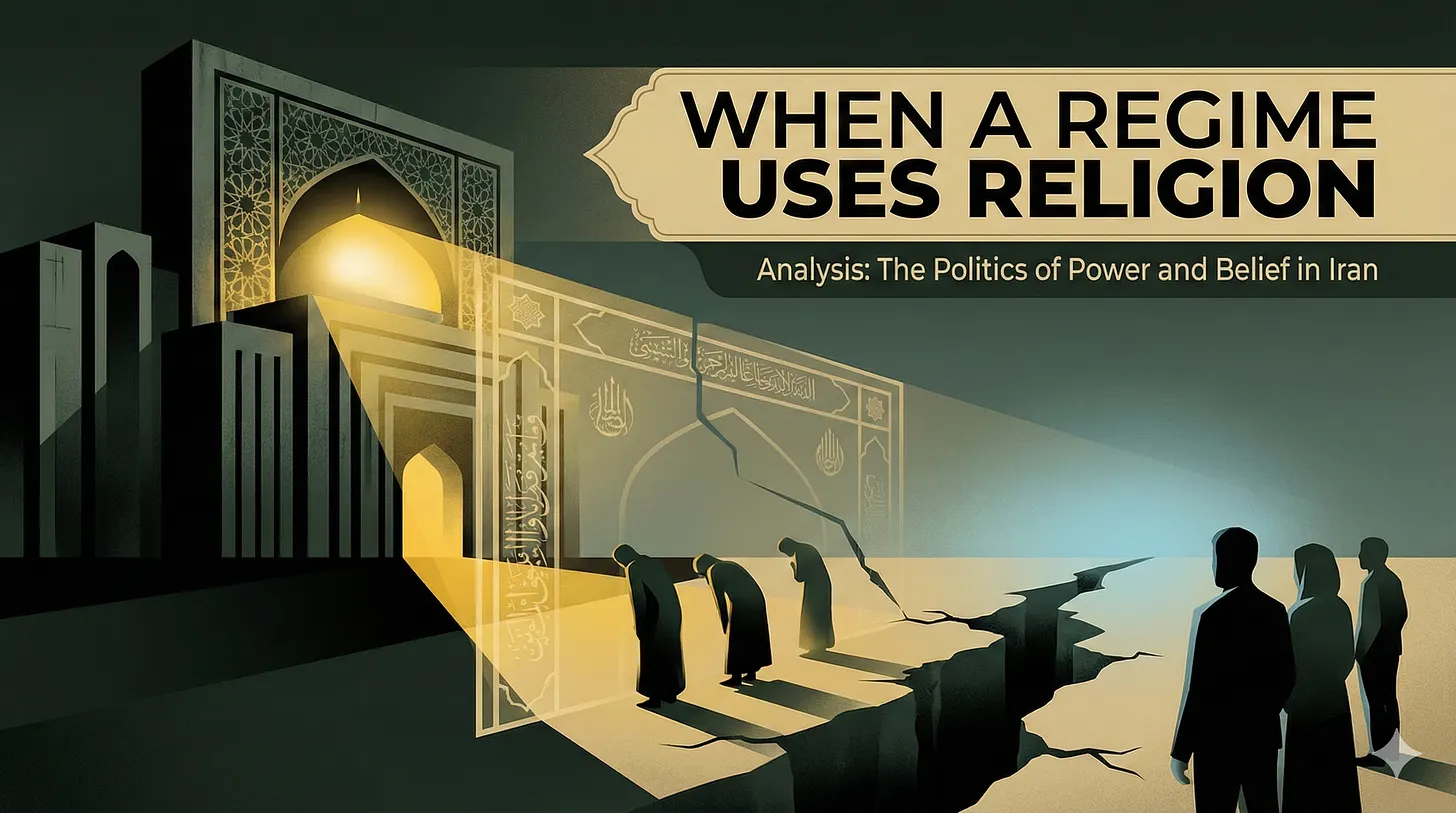
In Iran, religion is not only practiced. It is invoked as a foundation of political authority.
Since the revolution of 1979, the country has been structured as an Islamic Republic. Religious leadership within this framework is not merely spiritual, but institutional. The Supreme Leader stands above elected government and parliament, exercising direct influence over the military, the judiciary, and the state’s media apparatus.
This does not mean that repression is unique to religious states. Secular authoritarian regimes have often suppressed dissent with equal severity. But when political authority is formally grounded in a religious interpretation, repression acquires an additional dimension.
Political opposition can then be reframed not only as a threat to public order, but as a deviation from the religious legitimacy upon which the state claims to rest.
Protests such as those in 2019 and 2022, during which thousands were detained and some later executed, can be cast not merely as disruptions to civic stability, but as challenges to the moral and theological order of the polity itself. The demonstrations that followed the death of Mahsa Amini in 2022 were, according to UN rapporteurs, met with lethal force, torture, and coerced confessions.
The confirmed death of Supreme Leader Ali Khamenei, acknowledged by Iranian state media on 1 March 2026, has brought these tensions into renewed focus. While the government declared forty days of national mourning, international media and eyewitness accounts from cities such as Isfahan, Karaj, Shiraz, and Kermanshah reported that segments of the population responded with relief, and in some cases with open celebration, even as other regions witnessed mass expressions of grief.
In the wake of Khamenei’s death, with mourning and relief unfolding side by side, it becomes evident that religious legitimacy and political loyalty do not necessarily coincide.
Many Shiite Iranians, particularly those aligned with reformist or secular currents, have long expressed discomfort with the ways in which the regime deploys religious language to consolidate authority. Religious minorities such as Baháʼís and Christian converts continue to face exclusion from education and employment, while even Sunni Muslims report limited access to administrative positions within an overwhelmingly Shiite state apparatus.
When religious legitimacy is fused with state power in this manner, a consequential dynamic emerges.
Criticism of the political system can more readily be translated into hostility toward the faith that system claims to embody. The distinction between opposition to a government and opposition to a religious community becomes increasingly difficult to sustain.
This dynamic does not remain confined within national borders.
When an attack on military command structures is presented as an attack on “Muslims,” a conflict rooted in political and strategic considerations may be reframed as a civilizational confrontation. Notably, this interpretation is not widely shared across the Islamic world.
Sunni governments in the Gulf, including Saudi Arabia and the United Arab Emirates, have repeatedly voiced concern over Iran’s theocratic influence in the region. The longstanding tensions between Sunni and Shiite political models underscore that the present confrontation is not a conflict with Muslims as such, but with a particular form of statehood and its associated power structures.
In moments of existential crisis, nearly all regimes reach for unifying rhetoric. Yet even under such conditions, the decision to frame a conflict in religious terms, rather than solely as an attack on sovereignty, carries political consequences.
A conflict presented as a dispute between states may, in principle, be resolved through negotiation.
A conflict framed as a struggle over religious identity is often harder to contain, as it reaches into questions of belief, belonging, and collective meaning.
Context:
The Signals We See, The Signals We Miss
https://jeroenkjmsparla.substack.com/publish/posts/detail/189447204
The Ghost in the Machine: When Data Dissolves the Drama
https://jeroenkjmsparla.substack.com/publish/posts/detail/188523234
The Choreography of War: When a Ceasefire Is Only a Scene
https://jeroenkjmsparla.substack.com/publish/posts/detail/176573366