Original text
In recent years, many people have come to feel that the world is getting worse. Conflicts seem to multiply, political systems appear more fragile, and crises follow one another with little pause. Stability feels temporary. Uncertainty feels constant.
At the same time, long-term indicators often tell a different story. Child mortality continues to decline in many regions. Access to education has expanded. Renewable energy capacity is growing rapidly. Medical research keeps turning once fatal diseases into manageable conditions.
How can these two experiences exist side by side?
Part of the answer may lie not only in what is happening in the world, but in how we perceive and process what is happening. Our information systems are not neutral mirrors of reality. They are designed to detect deviation.
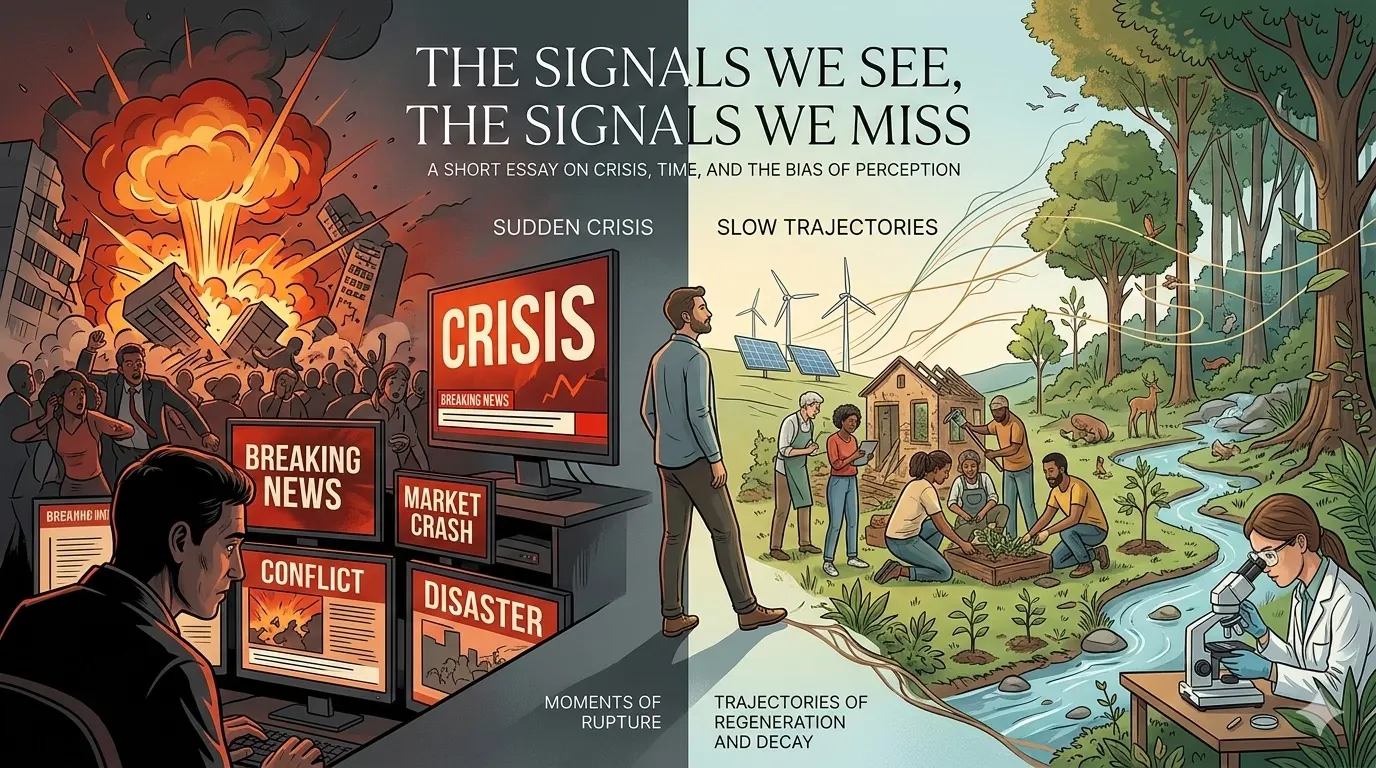
When something breaks, fails, or escalates, it is quickly recognised as meaningful. A war, a market crash, a technological failure, or a political scandal becomes an event. It has a beginning, a visible impact, and often someone to blame. It fits easily into a story with tension and consequence.
Repair works differently.
When an ecosystem slowly recovers, when infrastructure becomes more reliable, or when institutions improve their coordination, these changes rarely appear as events. They unfold gradually. They have no clear starting point and no dramatic peak. They are often experienced as the absence of a problem rather than the presence of progress.
Because of this, they receive less attention. They are less likely to be shared. Over time, they fade into the background of what we consider normal.
Yet there is an important nuance.
Our systems do not only struggle to detect slow improvement. They also struggle to detect slow deterioration. Climate change did not arrive as a single dramatic explosion. The erosion of democratic norms rarely happens in one visible step. Biodiversity loss unfolds quietly, often outside daily awareness.
In this sense, our perception is not simply biased toward crisis over repair. It is biased toward the sudden over the structural.
There is also an asymmetry built into us. Negative deviations tend to weigh more heavily than positive ones. Sudden loss or threat captures attention faster than gradual gain. When decline crosses a visible threshold, it spreads quickly through social networks. It creates a shared space of alarm. People talk about it, media amplify it, platforms accelerate it. Attention becomes contagious.
Slow processes do not spread in the same way. They lack a viral loop. They accumulate quietly, often fragmented across domains and institutions.
As a result, sudden breakdowns dominate the collective imagination, while long-term movements, whether regenerative or destructive, remain harder to grasp. If we fail to notice slow decline, we respond too late. If we fail to notice slow recovery, we underestimate our capacity to adapt.
Slow deterioration carries a second risk. When it finally crosses a visible threshold and becomes an event, our response often remains trapped in the logic of the sudden. We treat structural erosion as if it were an isolated shock. We mobilise quickly, but narrowly. We address the symptom that has become visible, while the deeper trajectory that produced it continues largely unchanged.
In this way, even our reactions can reinforce the bias toward the immediate. We extinguish the fire without asking how the landscape has been drying for years.
This is not merely a media problem. It is an epistemic and temporal one.
If our feedback systems amplify short-term disruption but filter out long-term trajectories, then our shared understanding of reality will be shaped by shocks rather than patterns. History begins to feel like a chain of ruptures instead of an evolving landscape.
Collective perception does not remain abstract. Over time, it shapes emotional culture. What a society repeatedly attends to becomes what individuals expect. When shared attention is dominated by rupture, volatility becomes internalised as normal.
If perception is structurally tuned to the sudden, emotional life will mirror that volatility. Stability will seem provisional. Direction will seem uncertain. Hope will feel fragile because it lacks visible drama. Progress will feel unreal because it unfolds without spectacle.
At the same time, slow deterioration can normalise itself. What advances gradually becomes part of the background before it is recognised as structural decline. By the time it erupts into crisis, it has already reshaped the terrain.
In both directions, the distortion lies in the rhythm of perception.
Intelligence, in this light, is not only the capacity to react quickly to danger. It is also the capacity to remain attentive to gradual change, whether it leads toward decay or toward repair. It requires memory, patience, and resistance to the constant pull of the immediate.
A society that cannot perceive duration clearly may still move quickly. It may even appear decisive. But it may not know where it is going, only what it is reacting to.
And in such a condition, the difference between crisis and trajectory becomes harder to see.