In this essay
Original text
In Greenland and the Return of Power, we argued that the world is no longer best understood as a collection of sovereign states bound primarily by shared rules. It is increasingly a network of nodes, places where physical position, economic leverage, infrastructure, and control over flows converge. Power in this world is exercised less through treaties and more through access, denial, and pressure. Rules still exist, but they no longer automatically protect. They persuade only when backed by capacity.
Davos, in the winter of 2026, offered a rare moment in which that analysis became visible in real time.
High in the Alps, surrounded by snow and ritual, political leaders, executives, and institutions gathered once again to speak the familiar language of dialogue, cooperation, and shared values. The vocabulary was intact. The tone was earnest. The moral grammar of the postwar order was carefully rehearsed. And yet, beneath the speeches, another language was being spoken elsewhere, quieter perhaps, but far more decisive. The language of leverage.
What Davos revealed this year was not hypocrisy, but lag. Not bad faith, but temporal dislocation. Davos still speaks the language of rules, while the world outside increasingly responds only to power. The problem is not that Davos lacks power, but that it still assumes power listens to its language.
1. Caretakers and owners
In the Greenland essay, we described Denmark’s position as that of a caretaker rather than an owner. Responsible for stewardship, legitimacy, and continuity, but lacking the freedom to impose outcomes through force. The United States, by contrast, behaved like a prospective owner, speaking in terms of acquisition, control, and security entitlement.
That same distinction replayed itself in Davos.
European leaders spoke of principles. Of sovereignty as non-negotiable. Of international law and shared responsibility. The words were familiar, and in isolation, correct. But as these speeches unfolded, a parallel reality intruded. The American president publicly reiterated tariff measures against countries aligning with Denmark. The threat was neither abstract nor symbolic. It was dated, quantified, and enforceable.
The contrast was stark. While Europe articulated why Greenland should not be treated as an object, the United States demonstrated how treating it as a strategic asset could be operationalized through economic pressure. This was not a misunderstanding between allies. It was a collision between two operating systems.
The caretaker speaks in norms. The owner speaks in consequences.
The significance lies not in who is right, but in which language produces effects. In a world where leverage works faster than legitimacy, the caretaker’s vocabulary begins to sound ceremonial.
2. Fragmentation as structural vulnerability
Davos also exposed something more uncomfortable: European fragmentation is not merely political, it is structural.
Publicly, European leaders promised unity and proportional response. Privately, divisions were evident. Countries with export-heavy industries calculated exposure. Governments whose economies depend on automotive manufacturing, advanced machinery, or transatlantic trade quietly assessed the cost of defiance. The question was no longer whether Europe agreed on principles, but how much each member could afford to pay for them.
This is not a failure of character. It is a design limitation.
The European Union was built to optimize rules, harmonize standards, and reduce friction in a world where rules were the dominant currency. It was never designed to absorb sustained external coercion applied asymmetrically. When pressure is applied through tariffs rather than tanks, fragmentation becomes not an accident, but an outcome.
This is precisely the corrosion of precedent we warned about earlier. Once power proves more effective than rules, unity becomes conditional. The moment leverage works, solidarity acquires a price tag.
What Davos revealed is that European cohesion still depends on the assumption that rules ultimately prevail. When that assumption fails, the structure begins to creak.
3. The return of power across regions
Greenland is not an isolated case. Nor is it exceptional.
The same logic is visible elsewhere. In Venezuela, American actions have effectively denied access to energy resources for geopolitical rivals. In the Arctic, pressure on Greenland serves to limit Russian and Chinese reach into a strategically vital region. Different contexts, different legal frameworks, but the same operational logic: control is achieved not through ownership, but through denial of access.
This is not about legality versus illegality. It is about capability. About who can shape access, flows, and chokepoints.
In this sense, Greenland and Venezuela are not analogies, but echoes. They demonstrate a return to influence defined by spheres, not norms. Control is asserted not necessarily through annexation, but through exclusion. Resource denial replaces territorial conquest. Access becomes the prize.
At the same time, leverage is not costless. It works quickly, but it is rarely stable. The more power is exercised through denial and pressure, the more it invites counter-nodes, rival infrastructures, hardened blocs, and parallel systems designed explicitly to escape control. Leverage accelerates outcomes, but it also accelerates resistance.
European leaders in Davos appeared unsettled by this bluntness. Not because they failed to understand it, but because they lacked an answer. Their own autonomy, as our earlier essay noted, has never been fully underwritten by hard power. Europe excels at regulation, coordination, and legitimacy. It struggles with compulsion.
In a world increasingly governed by leverage, this imbalance becomes visible.
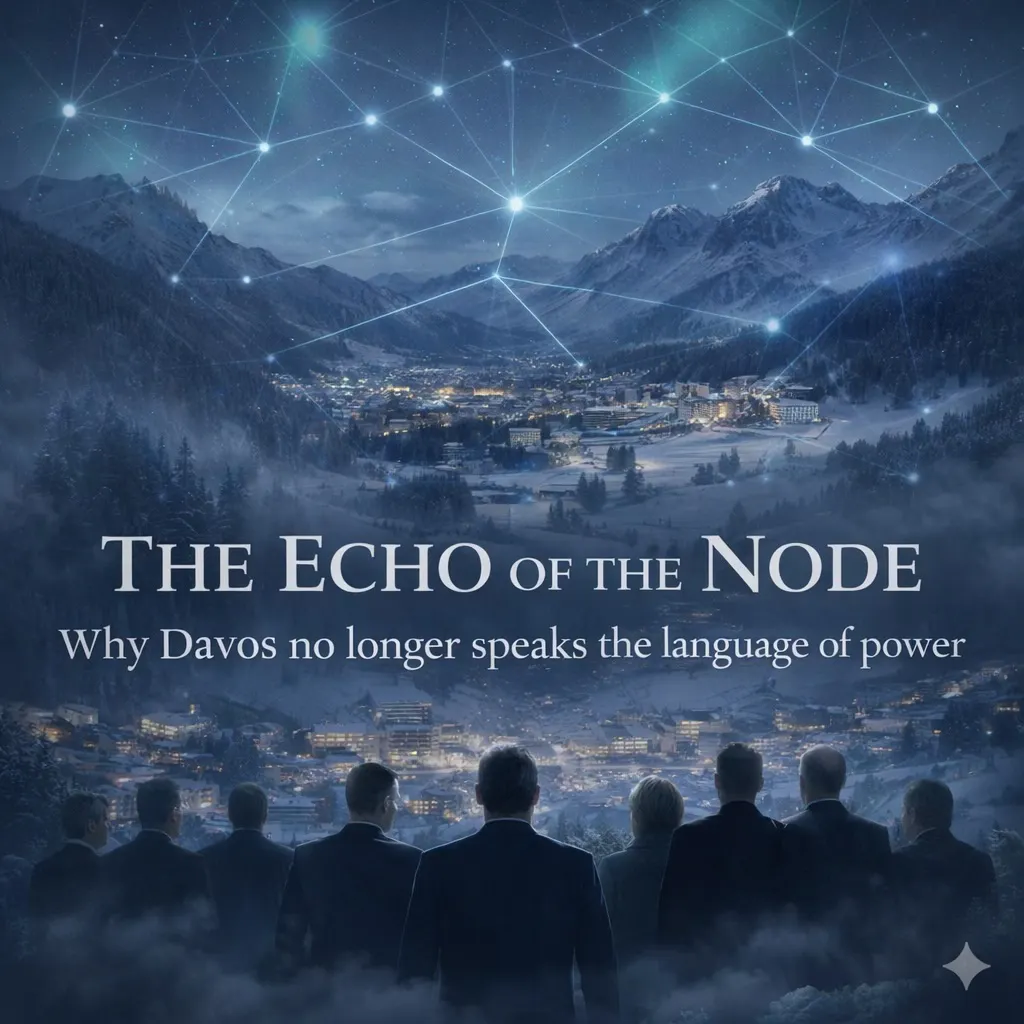
4. Davos as a resonance chamber
Davos was once imagined as a place where the state of the world could be shaped through dialogue. Today, it functions more as a resonance chamber, amplifying values that no longer determine outcomes.
This is not to say Davos is useless. It still matters as a signaling environment. But signals without enforcement travel poorly in a world of hardened incentives.
The most telling moments in Davos this year were not the plenary speeches, but the side conversations. Quiet recalculations. Contingency planning. Discussions about supply chains, tariffs, dependencies, and exposure. These were not conversations about values, but about risk.
Even attempts to soothe tensions revealed the shift. Appeals to “shared Arctic security” acknowledged, implicitly, that protection is now priced. Security is no longer a given of alliance membership. It is a service negotiated alongside trade concessions and strategic alignment.
The old rule was simple: allies were protected because they were allies. The emerging reality is more transactional: protection follows leverage, access, or strategic utility.
Davos still speaks the old rule. The world responds to the new one.
5. The keepers of rules and the keepers of nodes
What Davos ultimately revealed is a deeper asymmetry.
Europe and its institutions remain the keepers of rules. They safeguard process, legality, and procedural legitimacy. They ensure continuity. They maintain the archive of norms that once structured the system.
But power has shifted to the keepers of nodes.
Those who control energy routes, data centers, semiconductor production, maritime chokepoints, financial clearing systems, and military positioning increasingly determine outcomes. Their influence is not moral, but infrastructural. Not universal, but decisive.
As long as Europe refuses to fully understand power as something that operates beyond paper and procedure, it will remain a caretaker of an inheritance whose ownership is being renegotiated elsewhere.
This does not mean rules are irrelevant. It means they are no longer sufficient.
Epilogue: when language and power diverge
Davos 2026 did not fail because leaders spoke about values. It revealed something more troubling: that values are now spoken in a world already governed by leverage.
The danger is not that rules disappear. The danger is that language and power drift so far apart that they no longer recognize each other. When that happens, dialogue becomes ritual, and legitimacy becomes decoration.
The world we are entering is not lawless. It is selective. Order still exists, but it is no longer evenly distributed. Stability is no longer automatic. It must be actively sustained, and often paid for.
In Greenland and the Return of Power, we described the structural shift. Davos shows us its echo.
The question that remains is not whether Europe believes in rules. It clearly does. The question is whether it is willing to inhabit a world in which belief alone no longer shapes outcomes.
After Davos, postponement itself becomes a choice, and choices reveal priorities.