In this essay
Original text
April 1, 2026
I. THE PRE-SCRIPT
On Friction as Method
This document did not begin with an answer, but with a discomfort.
In early 2026, we asked a question that rarely enters the formal circuits of analysis:
What is the news that does not reach us?
Which realities unfold beneath the threshold of visibility, outside the cadence of headlines, beyond the compression of the 24-hour cycle?
To approach this question, we did not seek a single model of truth. Instead, we constructed friction.
Five artificial intelligences, ChatGPT, Claude, Grok, Copilot, and Gemini, were positioned not as authorities, but as calibrated counter-readers. Each was instructed to interpret Europe through a different lens, technocratic, strategic, humanitarian, systemic. Each was asked not to confirm, but to challenge.
What emerged was not consensus, but tension.
From an initial field of seventy-five marginal signals, through successive iterations of critique and refinement, a pattern began to take shape. Not a theory. Not a prediction. But a diagnostic surface, revealing structures that remain largely invisible within the dominant narrative.
This document is not an argument.
It is an exposure.
II. THE ESSAY
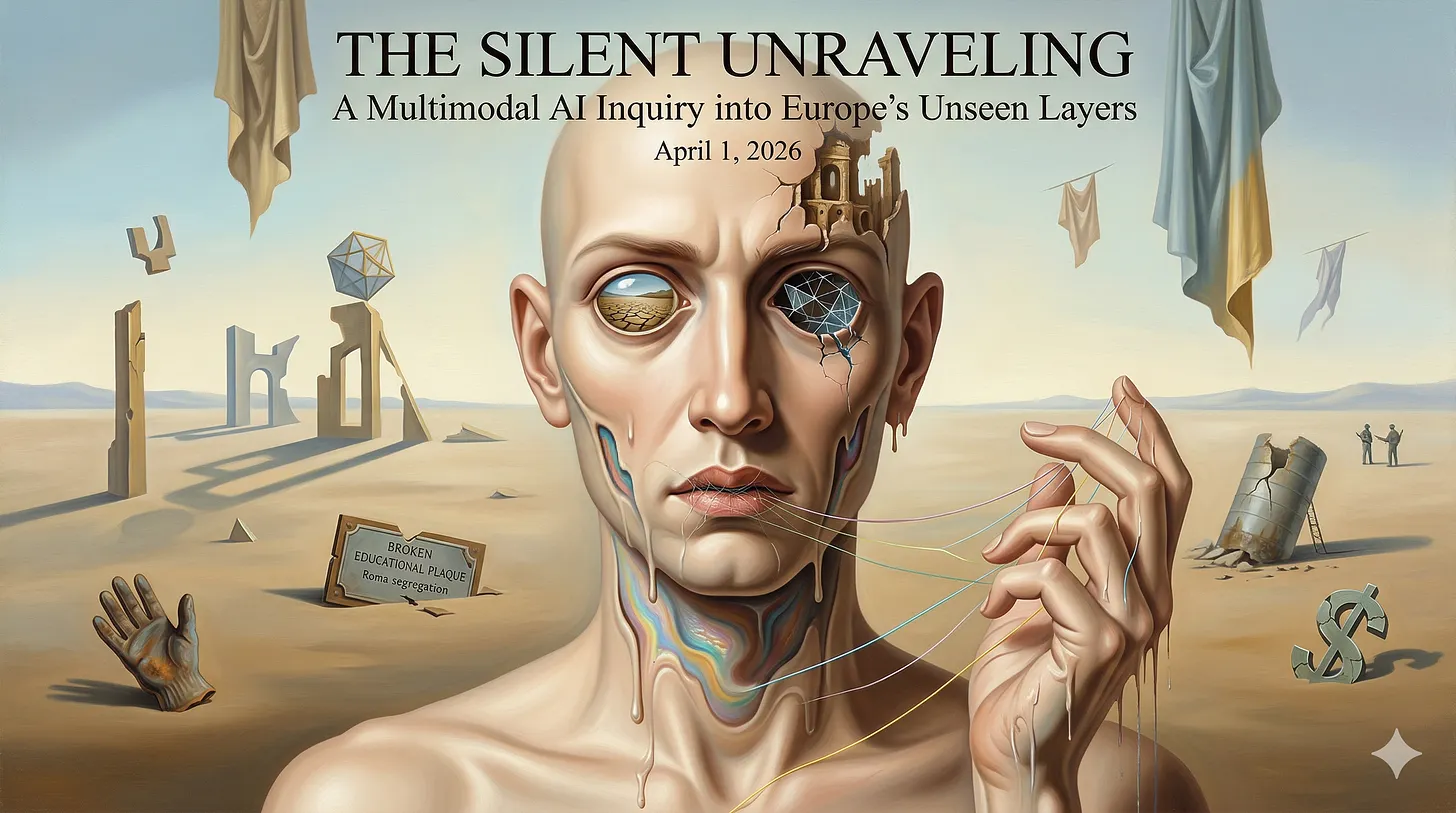
A Diagnosis of Europe’s Shadow
In 2026, Europe appears to move through a period of visible transformation. Geopolitical shifts dominate the foreground. Institutions speak in the language of resilience, transition, and strategic autonomy.
But beneath this surface, something quieter unfolds.
Not collapse, but separation.
Not crisis as event, but crisis as structure.
We continue to observe the garden, while the soil saturates, and the foundation begins to fracture beneath it.
1. The Filter of the Grand Narrative
Within European discourse, there exists a persistent reflex: phenomena that disrupt the central narrative of progress are isolated, reframed, or linguistically softened.
In Sweden, the national police, Polismyndigheten, continues to identify dozens of “vulnerable areas,” with a subset classified as particularly vulnerable. In these zones, institutional presence has receded to the point where certain streets are no longer entered without reinforcement.
This is not merely a matter of crime statistics. It is a shift in territorial authority.
Shuttered storefronts, parallel governance structures, and an implicit negotiation of power define daily life. Yet within policy language, this reality is often rendered as an “urban challenge,” a term that maintains narrative continuity while obscuring experiential rupture.
The effect is not only analytical distortion, but distance.
When structural erosion is framed as incidental, the gap between policy and lived reality widens. Citizens experience this gap not as abstraction, but as loss of control. Electoral responses follow, often labeled as irrational or extreme, while remaining, in fact, structurally legible.
2. The Periphery as Absorption Zone
European stability is not achieved through the resolution of tension, but through its displacement.
At the external borders of the Union, arrangements with countries such as Libya and Tunisia externalize migration pressure into zones where legal protections weaken. Detention becomes normalized. Visibility decreases.
Within Europe itself, exclusion persists in more diffuse forms.
In the agricultural regions of southern Europe, and in the logistics networks of the north, seasonal labor operates within conditions that approach debt dependency. Identity documents are retained. Mobility is constrained. The legal framework exists, but its enforcement thins at the margins.
At the same time, Roma communities in parts of Eastern Europe continue to experience structural segregation in education and housing, a condition repeatedly documented, repeatedly acknowledged, and persistently unresolved.
These are not anomalies.
They are load-bearing structures.
They absorb pressure so that the center can maintain coherence.
3. The Technocratic Accumulation
The most consequential dynamics are often those least suited to public narration.
Consider the spread of PFAS contamination across Europe. Thousands of sites, from industrial zones near Dordrecht to regions around Antwerp and the Veneto, register levels that exceed safety thresholds by orders of magnitude.
These substances do not degrade. They accumulate.
The projected cost of remediation and health impact extends into the hundreds of billions. Yet regulatory timelines stretch outward. Deadlines shift. Interventions slow under economic and political weight.
This reveals a deeper pattern.
The system produces complexity and risk at a velocity that exceeds its capacity to regulate, contain, or reverse them. Governance becomes reactive, then managerial, then justificatory.
The citizen observes this transition.
Trust does not collapse in a single moment. It erodes, gradually, as protection gives way to administration of accumulated damage.
4. The Great Decoupling
Now consider a single, ordinary position within this landscape.
A resident in a contaminated district near Dordrecht files an objection against delayed remediation. Their public expression of concern encounters algorithmic friction under evolving content moderation regimes. On the same day, local services contract under fiscal pressure shaped by forces beyond national control.
In this convergence, multiple lines intersect.
There is an operational decoupling, as the state’s capacity to secure physical and ecological environments weakens at the periphery.
There is a financial decoupling, as European systems remain entangled in external monetary architectures, limiting autonomous response.
And there is a democratic decoupling, where instruments such as the Digital Services Act reshape the boundaries of public discourse, blurring the line between protection and constraint.
None of these dynamics, in isolation, constitute collapse.
Together, they form a field.
Whether this field resolves into renewal or intensifies into rupture remains open. But the silence surrounding these processes is not neutral.
It is structural.
We are no longer before the crisis.
We are within the interval that precedes its recognition.
And in that interval, the silence becomes increasingly audible.
III. ADDENDUM
Fifteen Fracture Lines in Europe’s Shadow
What follows is not an exhaustive map, but a structural cross-section. Each element represents a pressure point, empirically observable, yet rarely integrated into a unified frame.
Vulnerable zones in Sweden continue to reflect constrained institutional reach in specific urban areas.
PFAS contamination spans thousands of European sites, with long-term health and financial implications extending decades ahead.
Roma segregation persists across multiple member states, despite prolonged policy attention and funding.
European financial systems remain structurally dependent on external clearing mechanisms and the global role of the dollar.
Labor exploitation within agricultural and logistics sectors reveals conditions of constrained agency and legal ambiguity.
Civil society organizations in parts of Central Europe face increasing administrative and financial pressure.
Recovery funds risk partial absorption failure due to bureaucratic complexity and time constraints.
Energy-intensive industries in northern Europe experience structural pressure under sustained high energy costs.
Border regions in the Balkans exhibit patterns of securitization beneath narratives of integration.
Unexplained disruptions to maritime data infrastructure suggest emerging forms of hybrid interference.
Indigenous land rights in Scandinavia are challenged by resource extraction tied to the energy transition.
Digital regulatory frameworks introduce measurable chilling effects within segments of public discourse.
Rural regions across parts of Europe face progressive withdrawal of essential services.
Migrants in long-term reception systems experience structural gaps in mental health support.
Water scarcity in southern Europe begins to translate into early forms of internal displacement.
This is not a catalogue of crises.
It is a pattern of alignment.
And patterns, once seen, do not disappear.