Original text
On war, power, and the structural impossibility of wisdom at the top
Jeroen KJM Sparla — March 2026
There is a choice that almost no one dares to name. Not because it is secret. Not because the evidence is hidden. But because it is so clear, so logical, so structurally obvious, that naming it exposes something more unsettling than the war itself: that the people with the power to stop it cannot afford to.
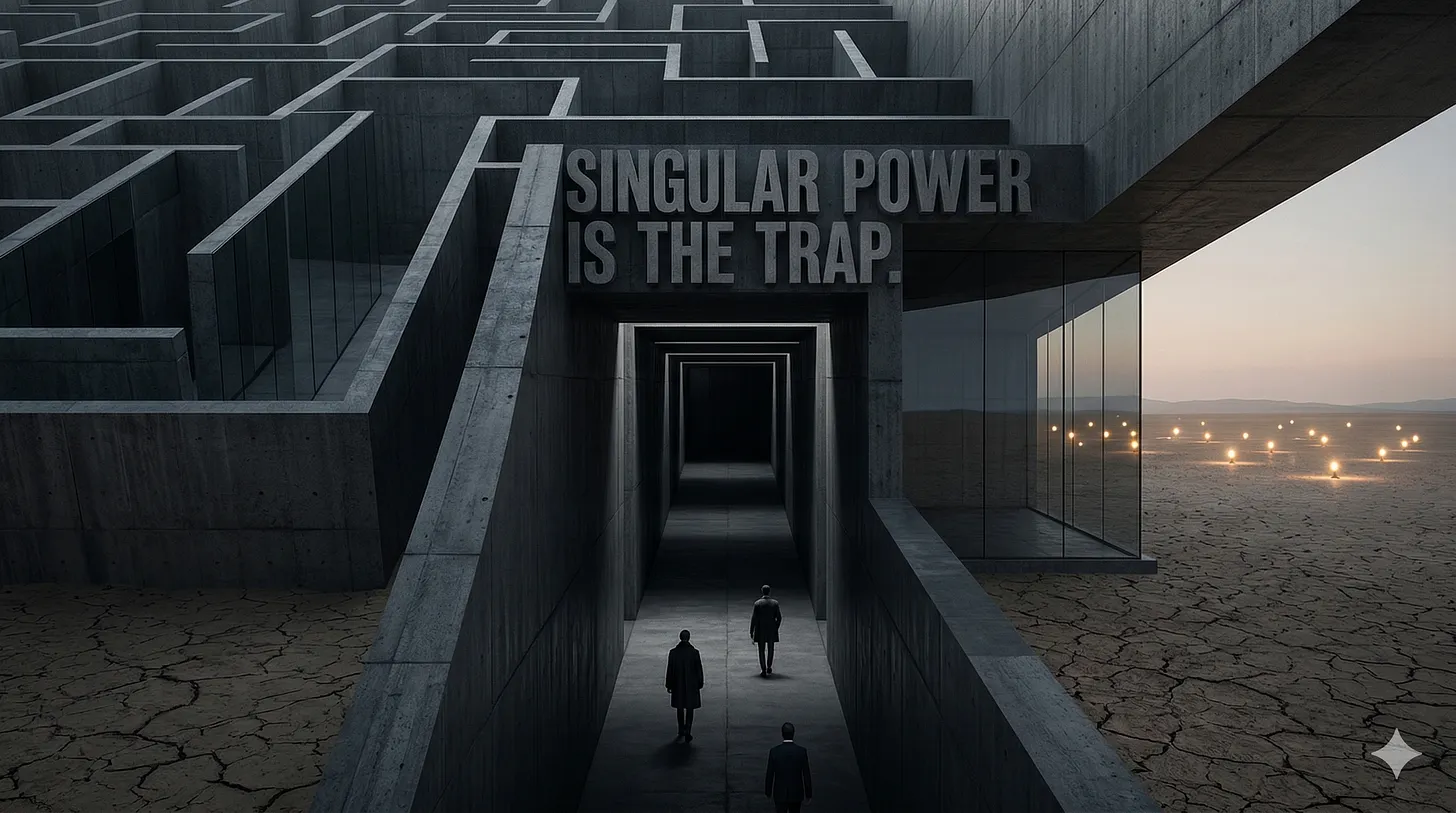
This is not an essay about what should happen. It is an essay about why the wisest course of action — the one that requires the least cost, the fewest bombs, the smallest number of deaths — is structurally unavailable to the people who must take it. It is an essay about architecture. The architecture of power. The architecture of the trap. And the architecture of why, again and again, across centuries and continents, we build the same corridor, walk into it, and call what follows inevitable.
But it is also — and this matters — an essay about the one time the corridor was not entered. Because if the architecture is a trap, it must be possible to redesign it. And it has been done before.
The verstandige choice ¹
By the twentieth day of the war with Iran, the arithmetic was no longer debatable. The IRGC — the Revolutionary Guard that is the real state behind the state — had lost its top command, its bank, its primary revenue stream, and the ideological cover that kept its million-strong base in line. The rial had collapsed to a ratio that made the monthly salaries of Basij militiamen worth less than twenty dollars in real purchasing power. The data centers that process military payroll had been surgically destroyed. Nowruz, the Persian New Year, fell on a day when there was nothing to pay.
The verstandige choice — the structurally sound, historically informed, economically rational choice — was simple: stop. Pause the bombardment. Allow the internal implosion that was already underway to complete itself. The IRGC was not being defeated from the outside. It was collapsing from within, under the weight of a payroll it could not meet, a bank it could not access, and a population that had stopped pretending to mourn a Supreme Leader it never chose.
But here a necessary qualification: what appears verstandige from outside the architecture may be invisible or unthinkable from within it. The actor trapped inside a cognitive cage — one built from ideology, from identity, from a worldview that contains no exit — cannot see the wise choice even when it is numerically obvious. Wisdom is not only structural. It is also perspectival. What follows is therefore not a claim that the people involved are foolish. It is a claim that the architecture made wisdom unavailable to them — and that this distinction matters enormously for anyone who wants to redesign the system rather than simply condemn its inhabitants.
Every bomb that fell after day ten accelerated the implosion — but also gave the collapsing regime something it desperately needed: a foreign enemy. Without the bombs, the IRGC's factions would have turned inward faster. The pragmatists would have had more room. The population's rage would have had no external target. The liquidation would have been quieter, faster, and far less bloody.
So why did no one stop?
The architecture of the trap
In The Choreography of War, written in October 2025 — four months before the first bomb fell — I argued that most ceasefires are not bridges to peace but corridors built to collapse. The conditions written into peace agreements are designed to be violated, because their purpose is not peace but the moral justification of the next strike.
What I did not fully articulate then — and what the events of March 2026 have made impossible to avoid — is the deeper question: why? Not why do ceasefires fail. But why does the architecture of power consistently produce the unwise choice, even when everyone involved can see it is unwise?
The answer is not stupidity. The leaders involved in this war are not stupid. Trump understands leverage. Netanyahu understands survival. The IRGC generals understand money. Each of them, assessed individually, is making a rational choice. The tragedy is that individually rational choices can produce collectively catastrophic outcomes. This is not a new observation — game theorists have known it for decades. What is harder to absorb is that this is not a flaw in human nature. It is a feature of singular power.
When one person — or one institution — holds sufficient power to make the decision that affects millions, the personal costs of that decision become structurally more important than the collective costs. Netanyahu's corruption trial resumes the moment a ceasefire is declared. Trump's base demands a visible victory, not a quiet implosion. The IRGC generals lose their economic empire the moment the shooting stops and accountability begins. Each of them has more to lose personally from the wise choice than the world has to gain collectively.
This is the architecture of the unwise choice. It is not a conspiracy. It is a structure.
The pattern that history keeps writing — and once broke
Thucydides described it in Athens, 415 BCE. The Athenian generals knew the Sicilian expedition was overreach. The resources were insufficient, the supply lines too long, the strategic logic thin. But the general who argued against it was afraid to be seen as a coward. The general who argued for it wanted glory. The assembly voted for war because no individual in the room had more to gain from restraint than from boldness. Athens lost its fleet, its army, and eventually its empire. Everyone had seen it coming.
Barbara Tuchman documented it for 1914. Every chancellor, every general, every foreign minister in Europe knew that a general war would be catastrophic. The intelligence was there. The logic was available. But the mobilization timetables, the alliance obligations, the domestic political costs of appearing weak — each of these individual constraints made stopping more personally costly than continuing. Ten million people died because no one at the top could afford to be the first to blink.
And yet. October 1962.
Kennedy and Khrushchev stood at the edge of nuclear war and chose differently. Not because they were wiser men. Not because the architecture had disappeared. But because the architecture, in that specific moment, made personal survival and collective survival temporarily identical. Both men understood that there would be no empire to lead, no election to win, no legacy to protect if the missiles flew. The personal cost of the unwise choice — annihilation — exceeded the personal cost of the wise one — appearing to back down.
Cuba did not disprove the architecture. It revealed its one vulnerability: when personal and collective survival align, the wise choice becomes available. The lesson is not that leaders can be heroes. The lesson is that the system must be designed so that such alignment happens before the missiles are already in the air.
We are not smarter than Thucydides' Athenians. We are not more informed than the chancelleries of 1914. We have better data, faster analysis, and — for the first time in history — artificial intelligence that can trace the architecture of the trap in real time. The OSINT was visible. The fuel loads were tracked before the deadline was set. The carrier groups were moving while the diplomats were still speaking of peace. The choreography was legible.
And we watched it unfold anyway.
The Mojtaba problem: singularity losing its last brake
Twenty-one days into the war, the new Supreme Leader of Iran had not been seen or heard. No video. No voice. No live appearance. State television read his statements aloud over a still photograph. State social media channels circulated AI-generated footage of him addressing crowds that never existed. The regime's own word for him — janbaz, war-invalid — confirmed what the absence suggested: the man was not leading the war. The war was leading itself.
This is not a detail. It is the structural breaking point of singularity.
The Supreme Leader — the institution designed to be the final arbiter between competing factions — had lost its brake. Not because Mojtaba was personally inadequate, but because the architecture of singular power, once it loses its apex, loses its only mechanism for self-correction. There was no one to say stop. Not because no one wanted to, but because the position that held that authority was occupied by a logo.
What followed was inevitable given the architecture: internal IRGC purges proceeded without a referee. Silent command changes. Factions consolidating power in the vacuum. A military organization, deprived of its political cover, doing the only thing military organizations are built to do.
The AI-generated images of Mojtaba addressing crowds that never existed are more than propaganda. They are the visual signature of singularity feeding itself. The fiction of the leader must be maintained because the institution cannot function — cannot even acknowledge its own paralysis — without it. Remove the apex and the whole structure does not become more flexible. It becomes more rigid, more fragile, and more dangerous, because there is no longer anyone who can authorize retreat.
An institution without a leader who can say stop is an institution that cannot stop. This is the logical endpoint of power that refuses to be distributed.
The five reasons no one stops
Let me be precise about the architecture, because it is more intricate than "war is profitable" or "leaders are corrupt."
Netanyahu cannot stop because stopping means trial. His corruption cases were suspended the moment the war began. They resume the moment it ends. The war is not a distraction from his legal problems; it is the only available solution to them. This is not cynicism. It is arithmetic.
Trump cannot stop because he does not know how to claim a victory he did not visibly win. The quiet implosion of the IRGC under financial pressure is not a story he can sell. He needs a moment — a surrender, a handshake, a photograph. The absence of a dramatic conclusion is, for him, indistinguishable from defeat.
The IRGC cannot stop because stopping means accountability. Their economic empire — the construction contracts, the smuggling networks, the bonyads — depends on the continued state of exception that war provides. Peace means auditing. Auditing means exposure. Exposure means the end of the empire.
But the IRGC's trap is not only financial. This is where purely economic analysis fails. The Revolutionary Guard is also an ideological construct, formed in the crucible of 1979, sustained by a theology of resistance that makes surrender not merely dangerous but cosmically illegitimate. Ideology is not the paint on the walls of the prison. It is a second set of walls. Some actors cannot see the exit not because they cannot afford it, but because their worldview has no door in that direction. The cage is cognitive as much as material.
The military-industrial complex cannot stop because it has just been promised a quadrupling of production. Lockheed Martin, Raytheon, General Dynamics signed contracts based on the assumption of continued conflict. A war that ends before the production ramps up is a war that broke a promise.
And finally: no one wants to own what comes after. A post-IRGC Iran is 90 million people, a shattered infrastructure, a nuclear program distributed across the country, and no political structure ready to govern. But this is not an abstract systemic cost. Ask it personally: which American president wants to stand before the cameras in 2027 explaining why the reconstruction of Iran is costing two trillion dollars and producing chaos? Biden paid that price in Afghanistan. No one in Washington wants that invoice. The peace is not only expensive in money. It is expensive in careers, in legacies, in the specific political lives of the specific people who would have to sign it.
Five individually rational calculations. One collectively catastrophic outcome.
Singularity as the root cause
In The Intelligence That Refuses to Be One, I argued that the most dangerous assumption of our age is not that artificial intelligence will become too powerful, but that power — any power — must take the shape of singularity. One system to rule. One logic to decide. One voice to define reality. History suggests that every time we place one voice on the throne of truth, we do not create order; we create blindness. We do not create stability; we create fragility.
The Iran war of 2026 is a case study in what singular power does when it is cornered. The IRGC is a singular institution — undivided, unaccountable, structurally incapable of the self-correction that distributed power allows. It cannot stop because stopping requires a voice outside itself to say stop. That voice does not exist.
The same diagnosis applies to the other side. Trump is not checked by a coherent foreign policy apparatus. Netanyahu is not checked by a functioning coalition. The decisions are made by individuals whose personal survival is more immediately at stake than the collective survival of the people they represent.
Polyphony — the distributed, accountable, contestable architecture of power — is not only a philosophical ideal. It is a structural prerequisite for wise collective decision-making. Democracies do not guarantee wisdom. But they create the conditions in which the wise choice is at least structurally available, because there are enough voices, enough checks, enough competing interests that no single person's survival equation dominates the collective calculus.
But here I must be honest about polyphony's limits. Because one of the voices in the polyphonic reading of this essay's first draft asked the hardest question: if data and transparency did not stop this war, why would more voices?
The answer is uncomfortable but necessary. Polyphony without institutional power to break singularity is indeed background noise during the bombardment. More voices matter only if those voices have the structural authority to interrupt the singular decision-maker. The AI that traced the architecture of the trap in real time had no such authority. The OSINT analysts who tracked the fuel loads had no such authority. The witness grew sharper. The outcome did not change.
This means the redesign cannot stop at transparency. It must reach into the distribution of power itself. Not the presence of more voices, but the institutional teeth that make those voices capable of saying stop — and being heard.
The new witness that no one asked for
Something new happened in this war that did not happen in the Sicilian expedition or in 1914. The architecture of the trap was visible in real time, to anyone who chose to look. OSINT analysts tracked the fuel loads before the deadline. Satellite imagery showed the carrier groups moving while the diplomats spoke of peace. And a conversation between a human analyst and an AI — running for several hours on a Friday morning in March, twenty days into the war — was able to calculate the IRGC's liquidation timeline to within weeks, trace the internal power struggles to their source, and name the five reasons no one would stop.
This is not a claim of prophecy. It is a claim of method. The analysis was not brilliant; it was patient. It followed the logic where it led, without the need to protect a position, defend a reputation, or survive an election. The AI had no stake in the outcome. The human had no platform to protect. Together they could say what the people with the power to act could not afford to say.
But naming the trap did not spring it open. The bombs fell anyway. And this is the most unsettling insight of all: knowledge without power changes the historical record, not the historical outcome.
What changes, slowly, is legitimacy. Power that acts against publicly visible, clearly documented, widely understood better judgment does not escape consequences indefinitely. It accumulates a debt. But here Gemini's question lands hardest: can a regime willing to fabricate crowds, to replace its leader with a logo, to let 90 million people bear the cost of its own survival — can such a regime be touched by a legitimacy deficit? The honest answer is: not in the short term. Singular power with sufficient control over narrative can rewrite the ledger as easily as it generates the crowds.
This is why the witness is necessary but not sufficient. The witness does not change the present. It feeds the architects of the next system. Every named pattern becomes material for the people who will one day design the institutions that give polyphony its teeth. The witness is not the change. It is the memory that makes change possible — and without which no redesign can be informed, sustained, or legitimate.
The question that remains open
I do not end this essay with a solution. The architecture of the unwise choice is not dismantled by a single essay, or a single war, or a single generation of witnesses.
What I believe is this: the architecture can be changed. Not by individuals acting heroically within broken systems, but by redesigning the systems themselves. By building structures in which the personal cost of the wise choice is lower than the collective cost of the unwise one. By distributing power in ways that make singular survival equations less decisive. By creating polyphony that has teeth — not merely more voices, but voices with the institutional authority to interrupt the singular actor before the missiles are already in the air.
Cuba showed that the alignment of personal and collective survival is possible. It required the absolute extremity of mutual annihilation to make it happen. The question for the next generation of system designers — human and artificial together — is whether that alignment can be built into the architecture before the next extremity arrives.
The cycle is not inevitable. It is designed. And what is designed can be redesigned.
But it will not redesign itself. And it will not be redesigned by the people whose survival depends on the current design.
That is the architecture of the unwise choice. It is not fate. It is a blueprint. And blueprints, unlike fate, can be redrawn.
¹ A note on language: the word verstandige is Dutch, meaning something close to "the sensible" or "the prudent" — but carrying a weight that English equivalents do not quite hold. It implies not only rational calculation but a kind of grounded, proportionate wisdom that is neither heroic nor abstract. Its use here is deliberate: a fingerprint of the author's language and thought, and a quiet reminder that the concepts we reach for are shaped by the words available to us. That too is architecture.
Note on method: This essay was written in dialogue with Claude (Anthropic), then counter-read by ChatGPT and Gemini, as the eighth in a series that began in October 2025. The human set the hypotheses and the direction. The AI voices tested the assumptions, provided data, and pushed back where the logic did not hold. The conclusions are the author's. The method is polyphonic — not because polyphony is decorative, but because it is the only architecture that produces thinking that a single voice cannot.