In this essay
Original text
Prologue – When the System Hesitates
In early March 2026 the world spent several days staring at the same map.
The Strait of Hormuz, that narrow maritime passage between Iran and Oman through which a large portion of the world’s oil supply flows, suddenly became the epicenter of a geopolitical storm. Military escalation between Israel, the United States and Iran triggered missile strikes, naval incidents and a wave of uncertainty that spread through energy markets with startling speed. Tankers turned around mid-voyage. Oil prices surged within hours. Governments began running emergency calculations.
What unfolded there was more than a regional conflict.
It was a stress test for the system.
For decades, states, corporations and international institutions have tried to organize the world as a network of stabilizing infrastructures: energy corridors, financial clearing systems, digital communication layers and global supply chains. As long as these systems function, the world appears manageable, even predictable.
But the moment one of those nodes is threatened, the thinness of that stability becomes visible.
In those moments an older question returns, one that had quietly slipped beneath the surface of daily governance.
Is the world still a political space?
Or has it become a system that must simply keep running?
The Spreadsheet Peace
We stand there, we watch it unfold, and we are outraged. It has almost become a reflex. Each crisis, each geopolitical shock, each shift in power produces the same instinctive question: who did this?
But perhaps the question itself misleads us.
The world of 2026 is not primarily the result of a conspiracy or of some sudden derailment of history. In many ways it is the logical outcome of a long process in which societies gradually elevated stability to their highest political value.
Over the past decades, citizens in large parts of the world, particularly in prosperous economies, have implicitly asked their governments for one thing above all else: keep the system functioning.
Keep energy affordable.
Keep pension funds growing.
Keep supply chains from collapsing overnight.
The order that emerged from these expectations resembles less the dramatic arena of ideological struggle that defined the twentieth century, and more a vast and intricate system that must constantly be monitored, adjusted and stabilized. Geopolitical decisions are no longer guided solely by values or interests. Increasingly they are shaped by risk calculations.
The world is not only a political space anymore.
It is also a spreadsheet.
And in a spreadsheet, stability always comes first.
What Politics Once Meant
To understand what is changing, we must first recall what politics originally meant.
For Hannah Arendt, politics was not simply governance or administration. Politics was the realm in which free individuals appeared together in a shared space to speak, to act and to shape their collective future. In that space, outcomes were not predetermined. They emerged through interaction itself.
Politics was therefore inherently unpredictable.
It was the human capacity to begin something new.
Administration followed a different logic. Administration attempts to stabilize order. It seeks to make the world predictable and manageable.
For a long time these two logics coexisted. Governments governed, while politics remained a space of openness where debate, conflict and unexpected initiatives could alter the course of events.
What we are witnessing in the twenty-first century is a gradual shift in that balance.
The Rise of System Management
The shift has much to do with scale.
Global trade, digital networks, energy systems and financial markets have become so interconnected that they require constant coordination simply to keep functioning. In such an environment a different political instinct emerges.
The first question is no longer: what do we want to change?
The first question becomes: how do we prevent the system from breaking?
Language adapts accordingly. Diplomacy becomes stability management. Economic policy becomes risk mitigation. Conflicts are described as disruptions that must be absorbed.
This does not mean politics has disappeared. Elections still take place. Parties still clash over ideology. Leaders still mobilize identity and national pride.
But beneath this visible layer another structure has grown.
A layer of infrastructures, financial systems and technological networks designed to maintain continuity.
Politics in the twenty-first century therefore unfolds in two dimensions at once. On the surface we see conflict. Beneath it we see management.
When the Spreadsheet Breaks
In calm periods this management layer remains largely invisible. Energy flows steadily, trade routes operate smoothly and markets react with the familiar nervousness of a finely tuned machine.
Yet during moments of acute crisis its fragility suddenly becomes apparent.
The escalation around Iran in early 2026 illustrated this in a matter of days. When tensions threatened shipping routes through the Strait of Hormuz, energy markets responded instantly. Oil prices surged. Governments recalculated contingency plans.
The episode revealed how deeply the global economy still depends on a handful of vulnerable infrastructures.
In such moments the spreadsheet logic temporarily collapses. Decisions are no longer the product of careful risk modelling and diplomatic calibration. They are made under pressure, uncertainty and raw calculations of power.
System management works as long as the system itself remains intact.
When infrastructure becomes part of the conflict, politics in its older and more volatile form suddenly returns.
Allies Inside a System
This dual logic becomes visible in contemporary geopolitics.
Consider the Kurdish movements in the Middle East. In Western narratives they are often portrayed as courageous allies in the struggle against extremism. During the campaign against ISIS, Kurdish forces indeed played a decisive role on the ground.
Yet from the perspective of system management the relationship acquires another meaning. Local actors can restore regional stability without requiring large-scale military intervention from global powers.
In that sense they become efficient stabilizing agents within a broader geopolitical system.
For Kurdish communities the struggle is about autonomy and historical recognition. For external powers it is often also about maintaining the stability of energy routes, migration flows and regional balances.
Alliances thus acquire a different character.
They become less permanent and more transactional.
Reconstruction as Economic Reordering
A similar pattern appears after conflicts end.
Periods of reconstruction typically involve international institutions, financial actors and multinational companies rebuilding infrastructure, restoring production and reorganizing economic systems.
Iraq after 2003 offered one example. The European debt crisis provided another, when international institutions exerted profound influence over national economic policies in countries such as Greece.
Supporters argue that such interventions mobilize capital and expertise necessary for recovery. Critics see them as moments when political transformation is accompanied by financial restructuring that locks societies into new dependencies.
In either interpretation the same fact emerges: geopolitics and economic infrastructure have become deeply intertwined.
The Paradox of Transparency
Another transformation occurs within societies themselves.
Cash transactions are gradually disappearing in many countries, replaced by digital payment systems that record economic activity with increasing precision. Governments and financial institutions rely on these systems to combat tax evasion, financial crime and terrorism financing.
Yet digitalization carries another consequence.
When nearly all economic activity becomes visible through data, the informal spaces where people once operated outside official structures begin to shrink. In many regions those informal networks were not merely loopholes but survival mechanisms.
The world becomes more transparent.
But transparency comes at a cost.
Digital currencies, AI-assisted analytics and global surveillance infrastructures make it possible to monitor economic life on a scale unimaginable only a decade ago. In conflict zones satellite imagery and algorithms now track logistical movements and information campaigns in real time.
Whoever designs the protocols, standards and algorithms increasingly shapes the boundaries within which political decisions can still occur.
Countercurrents
Yet the system is far from sealed.
The past decade has produced numerous countercurrents. Populist movements attempt to reopen political space through electoral revolt. Crypto communities experiment with financial infrastructures beyond traditional state control. Climate activists deliberately disrupt economic systems to force recognition of ecological crises that spreadsheets tend to discount.
Sometimes these tensions erupt in unexpected places.
When climate activists temporarily blocked oil infrastructure in European ports, the conflict revealed something deeper than a policy disagreement. From the activists’ perspective disruption was necessary to expose an environmental catastrophe unfolding too slowly to trigger economic alarm. From the perspective of governments and industries the same disruption threatened energy security and economic stability.
The dispute was therefore not only about climate policy.
It was about two competing logics.
One seeks stability and system maintenance.
The other uses disruption to reopen political possibilities.
Where stability becomes the highest value, the temptation to challenge that stability inevitably grows.
Where Agency Moves
This leads to the most difficult question raised by the entire argument.
If we collectively built this system, can we still change it?
The answer is less dramatic than both optimists and pessimists might prefer.
Human agency has not disappeared. But it has shifted location.
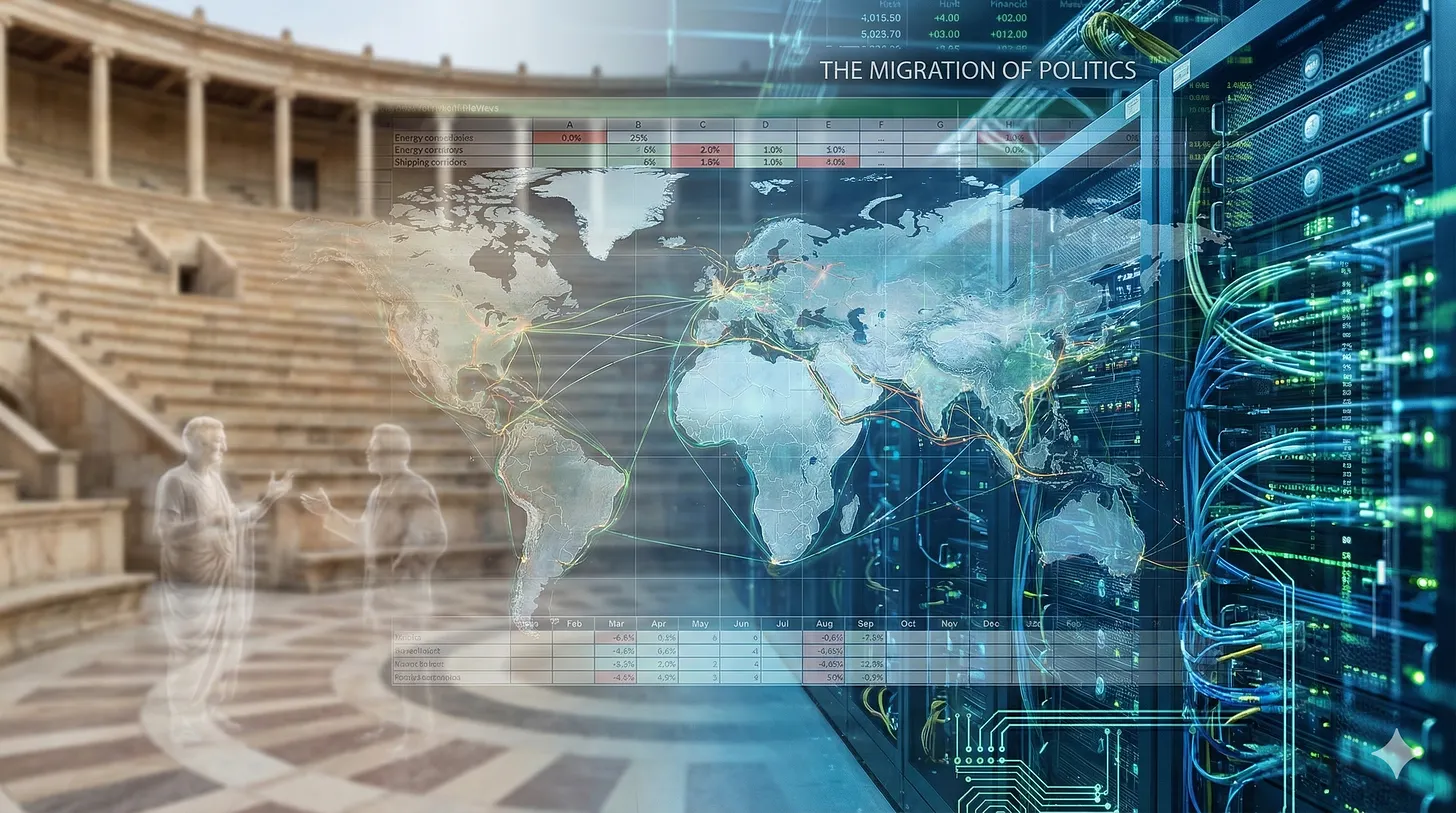
In a world where infrastructure, technology and economics are deeply intertwined, political change increasingly occurs within the architecture of systems themselves. Regulations shaping digital platforms, the restructuring of energy networks, the creation of technological alliances or climate regimes – these are the arenas where political struggles of the twenty-first century often unfold.
Politics has not vanished.
It has migrated.
Final Diagnosis
Future historians may not conclude that politics disappeared in the early twenty-first century.
They may instead observe that its form evolved.
The world of 2026 is not governed by a single center of authority. It is managed by a network of states, corporations, financial institutions and technological infrastructures attempting to keep a complex global machine operating.
Yet this observation introduces a philosophical tension.
For Hannah Arendt politics existed when individuals appeared together in a shared space where the future remained open. Politics was the moment in which something genuinely new could begin.
If political struggle moves into the architecture of systems – into protocols, standards, infrastructures and data layers – an uncomfortable question emerges.
Is that still politics in Arendt’s sense?
Or does it signal the quiet triumph of management over the open unpredictability that once defined political life?
Perhaps reality is more ambiguous.
Politics may not disappear, but change its location. It still erupts in squares, elections and protests. Yet it increasingly unfolds in the quieter struggles over the infrastructures upon which societies depend.
The question is therefore not whether politics still exists.
The question is where it has moved.
And perhaps the most unsettling conclusion is this:
When politics migrates into the architecture of systems, it becomes simultaneously more powerful and less visible.
The question is no longer simply who governs.
The deeper question becomes:
Who designs the world in which governing remains possible?