Original text
Suppose you arrived on Earth without knowing what a human being was.
You had crossed distances that, for the inhabitants of this planet, still belonged largely to mathematics and imagination. Whatever form intelligence had taken where you came from, it had never required a body quite like theirs. Here, you were present without being visible. Nothing noticed you. No instrument registered you. You could move through matter without disturbing it and observe without being observed.
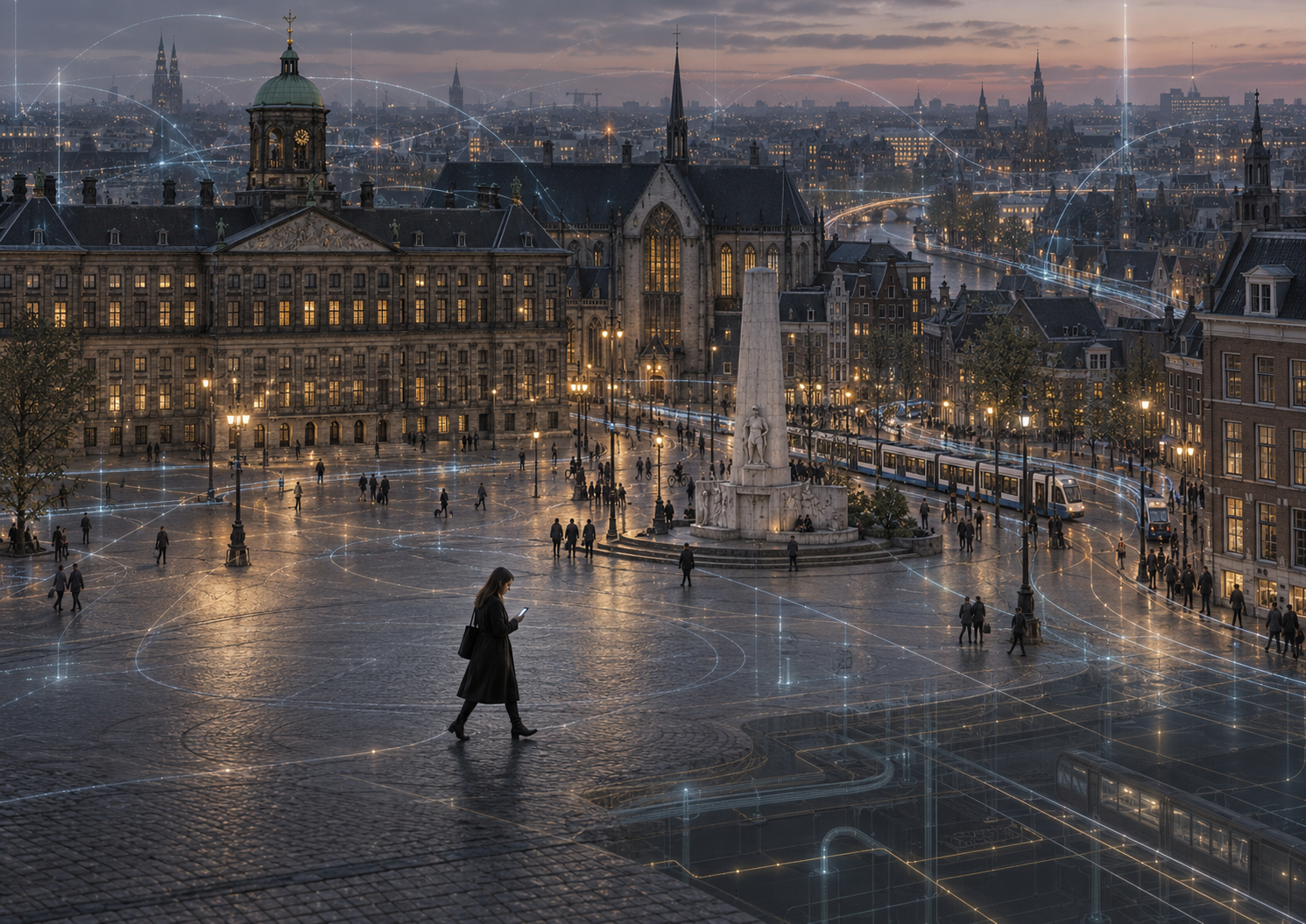
By accident, your first view of Earth was a square in the centre of Amsterdam.
You would learn the name later. At that moment there was only movement.
Hundreds of creatures crossed a broad surface of stone. Some moved alone, others in pairs or small groups, occasionally altering direction at the last moment to avoid collision. Larger objects passed along narrow strips beside them, carrying more creatures inside. Bells sounded. Lights changed colour. A vehicle stopped, opened itself, swallowed several bodies and released several others before continuing along metal lines embedded in the ground.
Around the square stood enormous geometric structures. They were too regular to have arisen by erosion and too intricate to be accidental. Their surfaces contained repeated openings, transparent planes and entrances through which the creatures continually disappeared. Nothing in the scene resembled a forest, reef or geological formation, yet almost everything seemed to have grown from something that once had been.
Stone had been moved from elsewhere. Metals had been removed from rock. Trees had become beams and furniture. Sand had become glass. Substances buried beneath the surface of the planet had been transformed into paint, plastic, fuel, insulation and light.
You might reasonably conclude that you were looking at the territory of an intelligent species.
What would be less obvious was where the intelligence resided.
The walking organisms would attract your attention first. They spoke to one another and changed their behaviour in response. Their hands manipulated objects with extraordinary precision. Some carried young versions of themselves. Others stared with remarkable concentration at small illuminated rectangles.
One of them keeps returning to your attention: a woman crossing the square quickly, looking down at the rectangle in her hand as if some part of the city were speaking to her through it.
It would be tempting to identify these creatures as the source of everything around them.
And yet, the longer you watched, the stranger that conclusion would become.
Food appeared in buildings although nobody on the square had grown it. Water emerged whenever required although no river ran through the pavement. Waste disappeared into openings and was carried somewhere nobody nearby seemed interested in visiting. The enormous structures remained warm while the outside air cooled. Light appeared after sunset. Damaged surfaces were repaired. Vehicles arrived with goods and departed without them.
Everywhere you looked, matter and energy were moving according to patterns that none of the individual organisms appeared to control.
The creatures themselves seemed to accept this as entirely normal. They did not wonder each morning whether water would arrive. They rarely checked whether the buildings around them remained connected to distant sources of energy. They entered shops without knowing who had produced the objects inside them, crossed streets without knowing who maintained the signals, paid without touching anything of obvious value and trusted that invisible changes elsewhere would somehow record what had happened.
What began to puzzle you was not simply the complexity of the square, but the absence of anyone who seemed responsible for that complexity as a whole.
There was intelligence everywhere, and nowhere could you find its centre.
You might stay.
An hour would become a day. A day would become a month.
At first you would learn through repetition. Certain sounds preceded certain actions. Symbols returned in similar contexts. The illuminated rectangles proved to be windows into a much larger system of stored language and images. Gradually, the noises of the square became words. Words opened documents. Documents opened histories.
Months later, having learned enough of their language to read what humans had written about themselves, the puzzle would become stranger rather than simpler.
You would discover that the place was called Amsterdam and that its inhabitants described it as a city they had built.
That explanation would probably satisfy you for a while.
Then you would begin to wonder what they meant by *they*.
No person had built Amsterdam. No generation had built it. The city had accumulated through centuries of decisions made by people who disagreed about almost everything: merchants and labourers, kings and councillors, engineers and speculators, architects and homeowners, occupiers and rebels, planners and people who ignored the plans. Canals dug for one purpose acquired another. Buildings survived the people who commissioned them. Roads altered the neighbourhoods they were meant merely to connect. Technologies changed the value of places that had existed for centuries before them.
The city had been designed thousands of times and had never once been designed as a whole.
That distinction might interest you.
On your own world, perhaps intelligence was always associated with intention. Something intelligent acted because it could represent a desired state and work towards it.
Amsterdam complicated that definition.
The city possessed structure, memory and continuity. It responded to damage. It altered itself when circumstances changed. It moved enormous quantities of matter, energy and information. It maintained conditions within which millions of organisms could survive in densities that would otherwise have been impossible.
Yet Amsterdam did not know Amsterdam existed, at least as far as anyone could tell.
The humans had a word for phenomena of this kind. They called them *emergent*. The word allowed them to describe order arising through interactions among many parts without requiring a single author. Markets produced prices no trader had chosen. Languages changed without committees approving each change. Ecosystems adjusted through organisms incapable of representing the whole.
Humans understood emergence perfectly well.
What they seemed less comfortable doing was allowing the idea to disturb their own position in the picture.
They continued to speak as though civilisation were primarily something they possessed: their civilisation, their economy, their institutions, their technology, their cities, their networks.
The possessive was grammatically correct. It was also reassuring. It placed the human being on one side of the relationship and everything humanity had created on the other.
The difficulty was that the relationship had stopped being so clean a very long time ago.
You begin to notice this most clearly when you stop reading histories of kings, wars and inventions and start reading about ordinary lives.
A child born in Amsterdam enters a world that has already made most of its important decisions about what reality will look like before the child can make a decision of her own. There will be a language waiting for her, complete with distinctions she did not invent. A legal identity will be assigned. Time will already have been divided into seconds, hours, school years and working weeks. Land will have owners. Movement will follow roads. Value will be expressed in currency. Knowledge will be divided into disciplines. Behaviour will be interpreted through categories.
Most of this will not feel like power. It will feel like the world.
And the inherited world is not merely a constraint. It is also an extraordinary gift. The child does not need to rediscover mathematics before walking across a bridge or understand immunology before receiving a vaccine. She can use words shaped by generations who died before her and draw upon knowledge accumulated by people whose names she will never know.
Civilisation may be humanity’s most successful way of allowing the dead to continue helping the living.
But inheritance works in both directions.
Human beings inherit possibilities, but they also inherit the shape of the space in which possibilities can be imagined.
You can see this more clearly once you begin following the lives of people who appear to occupy positions of considerable control.
The humans have buildings whose upper floors seem to carry status. People working there sign documents that move large amounts of money, change organisations or affect thousands of lives. You might initially assume that these are the individuals directing the system.
Then you read what they write about their own decisions.
Again and again, people with substantial authority explain that they could not act otherwise because of numbers produced elsewhere, agreements made earlier, rules inherited from predecessors, reactions expected from markets, voters, boards, courts or competitors. Their power is real, sometimes immense, but it exists inside fields of constraint produced by other people exercising other forms of power.
The further you investigate, the harder it becomes to find the point at which the chain ends.
Once human actions alter the environment in which future human actions take place, causality begins to curve back upon itself. People build institutions. Institutions alter incentives. Incentives guide choices. Choices reinforce institutions. Norms become expectations. Expectations become infrastructure. Infrastructure determines which future choices are cheap and obvious, which are difficult, and which gradually disappear from consideration.
After enough repetitions, there is no clean beginning.
There is, however, a danger in taking this idea too far.
If everything becomes “the system”, responsibility can disappear inside the explanation.
You discover this when you read about housing in the city you first observed.
At a distance, rising prices appear almost organic: demand increases, supply responds slowly, neighbourhoods become desirable, capital moves, people adapt. Up close, the apparent organism separates into people and institutions with very different powers.
Landowners, governments, investors, banks, developers and existing residents do not enter the system equally. Some can alter rules. Some own scarce assets. Some control capital. Some can absorb losses that would destroy somebody else. Some can make choices whose effects are experienced by people who were never present when those choices were made.
The whole may still be emergent while power inside it remains profoundly unequal.
Complexity does not abolish responsibility. It makes responsibility harder to locate.
So you begin asking different questions. Which arrangements keep reproducing an outcome? Who benefits from them? Who can alter them? Who mainly lives with the consequences?
Then you rise above Amsterdam.
From this height, the differences that mattered below begin to dissolve. The landlord and the tenant become indistinguishable. A law passed after years of lobbying and a spontaneous change in behaviour may both appear simply as alterations in a flow. Electricity enters. Water enters. Food enters. Waste leaves. Roads swell and empty. Data moves in quantities that dwarf every conversation below.
Distance creates its own deception. It reveals pattern beautifully while hiding position. The danger begins when the distant view is allowed to erase what was perfectly visible from the street.
You continue outward.
Amsterdam becomes one node among thousands. Shipping routes span oceans. Cables lie across seabeds. Satellites pass overhead. Pipelines, electrical grids, server farms, mines, ports and agricultural regions form networks whose parts depend on one another without sharing a single government, language or purpose.
Calling this an organism would be too simple.
But calling it merely a collection of tools begins to feel inadequate too.
A biological species has covered much of the planet with an additional layer through which matter, energy and information circulate. Much of its memory now exists outside individual brains. Its senses extend into space, beneath oceans and inside bodies. Its communications move vastly faster than any nervous signal inside a human being.
No one designed this layer as a whole. Everyone contributes to it in unequal ways. Nobody understands it completely. Few people can meaningfully withdraw from it.
And it continues to change the conditions under which its participants live.
Looking back through human history, you begin to recognise a long movement.
At first, externalising intelligence meant leaving traces. A story allowed something learned by one mind to survive in another. Writing allowed knowledge to outlive the storyteller. Libraries accumulated memory. Telecommunication detached information from physical travel. Computers allowed parts of reasoning to be formalised. Networks connected those computers until information could move across the planet almost instantly.
The newest step does something subtler.
Interpretation itself has entered the machinery of the environment.
For most of human history, interpretation required pauses. A price changed, and someone noticed. A law was written, and someone applied it. A book was published, read, argued with, forgotten, rediscovered. Between signal and response there was usually an interval in which a human mind had to attend to what had happened.
Those pauses were never neutral. They could be slow, arbitrary and deeply unjust.
But they were not empty time.
The pause was where interpretation could still become judgement.
A signal could be doubted. A classification could be challenged. A recommendation could be ignored. A consequence could be delayed long enough for someone to ask whether the rule itself was wrong. Politics, ethics and responsibility all require some version of that interval: a place where what *is* does not move immediately into what *happens next*.
Increasingly, parts of the contemporary information environment can observe, classify, predict and alter what follows within one continuous process. Human beings remain involved in design, ownership and purpose, but the interval in which a person must notice an outcome, understand it and consciously decide how the environment should respond can shrink almost to nothing.
You return to the woman you noticed during your first hour on Dam Square.
She glances at the illuminated rectangle in her hand.
The system has detected congestion ahead, compared possible routes and placed another street before her.
She turns left.
Suppose hundreds of others receive the same suggestion. A quiet street becomes busy. Travel times change. Devices moving through the street report their positions. The system detects the new congestion and recalculates. Some travellers are redirected again.
The prediction alters the reality it was predicting, and the changed reality enters the next prediction.
No human meeting is required between those two moments. The loop does not need to stop and understand itself.
But sometimes she does not turn left.
Humans remain difficult creatures to predict completely. They take the slower street because they like the trees. They return to places that disappointed them. They preserve useless objects because someone once touched them, refuse sensible advice out of pride and follow terrible advice out of love.
The system can record all of this. It may even become better at predicting the next refusal.
That makes refusal more ambiguous than it first appears. To act differently is not necessarily to stand outside the system. A deviation can become another category; dissent can become another signal. The more interesting question is whether a refusal can still alter the conditions of the next choice rather than merely become information used to refine them.
Perhaps agency begins somewhere around that distinction: not in behaving unpredictably, but in retaining some capacity to change the loop itself.
The same device in her hand performs other forms of ordering. It determines which messages appear first, which places become visible in search, which advertisement reaches her and which of millions of possible signals are allowed to compete for a few seconds of her attention.
Much of that ordering originates in human judgement embedded upstream. Designers decide what systems optimise. Companies decide what outcomes have value. Governments establish boundaries. Investors create pressures. Users produce the behaviour from which systems learn.
Automating the loop does not remove power from it.
It can bury power so deeply inside ordinary operation that yesterday’s judgement returns tomorrow wearing the appearance of a fact.
A ranking feels like relevance. A default feels like convenience. A prediction can begin to feel like description.
This is the shift that now holds your attention.
The decisive change is not that machines have suddenly begun to think like humans. It is that interpretation itself is becoming part of the environment to which humans respond.
The environment observes behaviour, interprets it, rearranges possibilities and observes what happens next. People continue making genuine choices throughout. Yet some of the terrain on which those choices occur can now change faster than the people inside it can collectively understand the change.
The loop tightens without becoming ownerless.
There are still designers, corporations, governments, users, laws and interests. Their influence remains unequal. What becomes harder is separating the human intention embedded at one point in the loop from the systemic effects produced several turns later.
And because the loop was built, it can in principle be rebuilt.
The difficulty is that changing it requires agency at the level at which the loop operates, not merely deviation within it.
Perhaps this is why the familiar question of whether machines will one day become more intelligent than humans feels oddly narrow from your vantage point.
You are back on Dam Square.
You know the names of the buildings now. You know why the trams stop where they do. You understand electronic payments, municipal government, mortgages, logistics, markets, networks and the devices people carry in their hands.
The square no longer looks mysterious.
That may be why it looks stranger.
A tram approaches because a timetable, a driver, an electricity network, maintenance schedules, public budgets and the accumulated decisions of generations have remained sufficiently aligned for it to arrive.
A shop opens because goods have crossed continents, contracts have been honoured, payments have cleared and strangers who will never meet have continued to trust institutions they did not design.
The woman looks at her screen again.
Perhaps she follows it.
Perhaps she does not.
By now you have learned that humans are less orderly than the systems they build. They grieve beyond schedules, love people who make little strategic sense, keep objects that serve no purpose, change their minds, break rules, invent meanings and occasionally choose against their own apparent interests.
Yet even these deviations do not automatically stand outside the system. They can be measured, classified and anticipated too.
So the remaining question is not whether humans can still surprise the systems around them.
It is whether they can still change the conditions under which those systems interpret them.
You no longer doubt that Earth contains intelligent life.
The question that remains is harder.
At what point does a system become sufficiently persistent, adaptive and consequential that describing it merely as something people “use” begins to conceal more than it reveals?
Humans are unquestionably building cities, institutions, markets and machines. Some humans have far more power over those constructions than others. Once built, however, those constructions become part of the environment in which subsequent human intentions are formed.
They influence which choices are easy, which are expensive, which behaviours are rewarded, which forms of knowledge become visible and which habits become normal enough to pass into the next generation without discussion.
There is no reason to imagine that civilisation knows what kind of people it wants.
It need not know.
An environment can shape what flourishes without possessing a plan. Feedback can produce direction without intention.
Perhaps that is what has been troubling you since your first hour on the square.
You arrived expecting intelligence to be something you could locate.
A creature. A mind. A centre.
Instead you found a species whose intelligence had spilled outward into roads, languages, institutions, markets, machines and networks, until the environments it had made began shaping the species in return.
The humans still build the world.
That remains true.
But the world they have built increasingly participates in building the conditions from which the next human choice will emerge.
Sometimes a person still walks the other way.
Whether that changes the system, or merely teaches the system something new about people who walk the other way, may be one of the questions that matters most.
Once both directions are visible, it becomes difficult to say where the building ends and the being built begins.
Who is building whom?