In this essay
Original text
The Hermits and the Patrons
In 1432 the Ghent Altarpiece was installed in a chapel founded by Joos Vijd and Elisabeth Borluut, two of the wealthiest citizens of Ghent. Hubert van Eyck began the work and his brother Jan finished it. At its centre stands the Lamb of God, whose blood runs into a chalice, and around the Lamb humanity gathers: apostles, martyrs, judges, knights and hermits, the last of them men who had left ordinary society to give their lives to prayer.
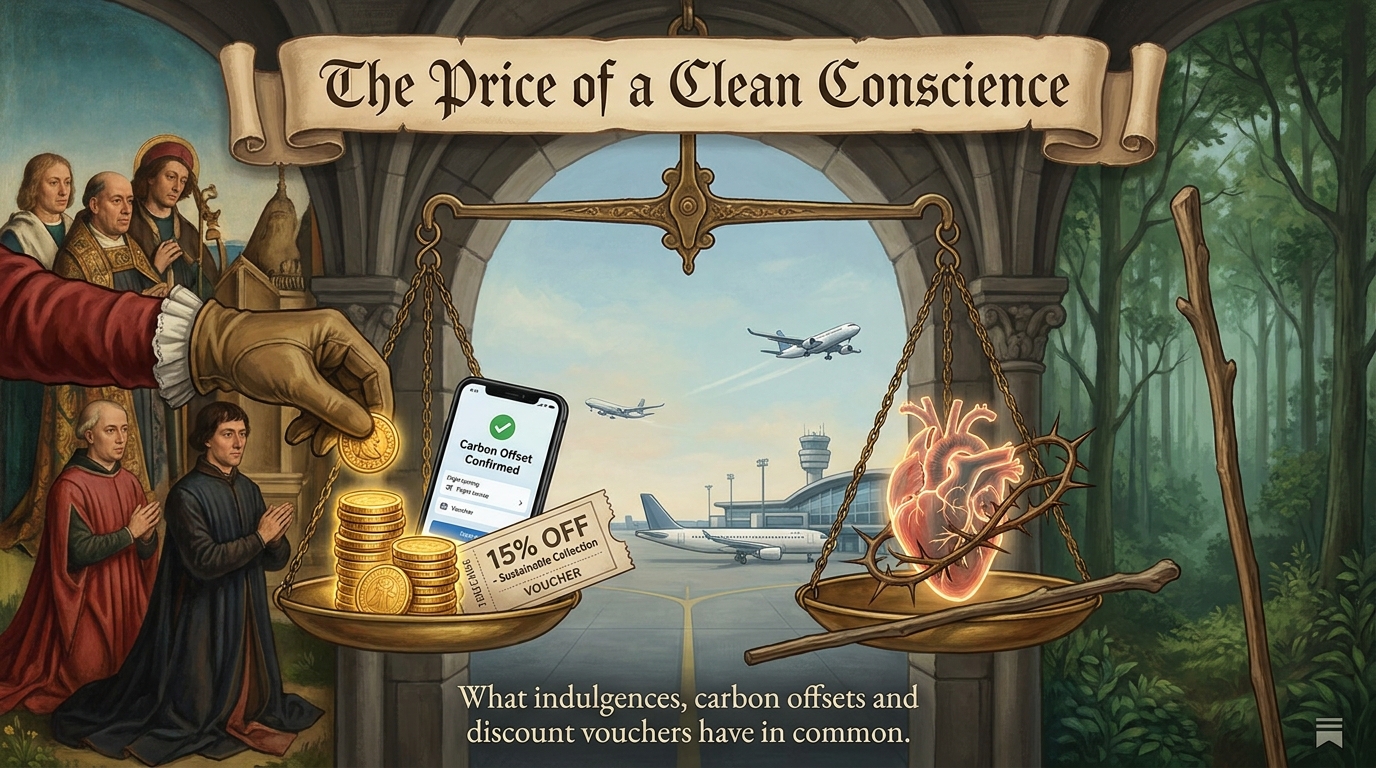
On an ordinary day, almost none of this could be seen. The altarpiece stood closed, and what the visitor saw was the exterior, where Vijd and Borluut themselves kneel on either side of the two Saints John. The hermits were inside, visible only when the panels were opened on feast days.
A document of 1435 shows what the couple had secured with their chapel: a Mass at its altar every day, for their salvation and that of their ancestors. None of this was unusual. Generosity towards the Church was a recognised expression of devotion, and also a way of obtaining prayers and public standing. We cannot know how the couple weighed those motives, and they may not have separated them.
The hermits offer a contrast, though not quite the contrast of poverty against money, since hermits often lived from the alms of patrons. The difference lies in what the faith asked each of them to change. The hermit rebuilt his life around his convictions. The patron kept his life and arranged for an institution to attend to his soul. Both counted as devotion, but the patron's arrangement was one an institution could administer for generations after the donor's death.
Nearly six centuries later a comparable arrangement appears when booking a flight, where a small extra payment offers to compensate for the emissions of the journey, and in a clothing shop, where handing in old garments earns a discount on new ones. The resemblance is one of structure, not of belief or feeling: certain remedies are easy to sell and hard to trust, and four questions, taken from the history of indulgences, help explain why.
The Business of Salvation
For medieval Christians the consequences of sin did not end at death. Purgatory was a period of suffering through which the soul was purified before reaching heaven, and an indulgence was the remission of the temporal punishment still owed for sins whose guilt had already been forgiven. The Church did not teach that forgiveness could be bought. But the line between a devotional act and a financial contribution became harder to hold in practice, above all after 1476, when Pope Sixtus IV extended indulgences to the dead. A living person could now act on behalf of a deceased parent or child. The theology spoke of intercession, but preachers could easily present it as something close to a guarantee.
By 1517 the interests surrounding the practice were thoroughly entangled. Pope Leo X wanted money for the rebuilding of St Peter's in Rome. Albrecht of Brandenburg owed a large debt to the Fugger bank, incurred in acquiring his ecclesiastical offices. In a widely told account, the proceeds of the indulgence preached in the German lands were divided between Rome and Albrecht's creditors. Each party could describe the deal in his own terms: believers gave to a sacred cause, the pope built a church, the banker was repaid. Nobody needed to be a cynic for the deal to work.
The Dominican Johann Tetzel became the face of the campaign. Whether he really said that a soul leaps from purgatory as soon as the coin rings is disputed, but Luther attacked the claim in the twenty-seventh of his Ninety-Five Theses. In the next, he observed that a ringing coin can certainly increase greed, while what the Church's intercession achieves rests with God alone. In thesis 86 he asked why a pope richer than the richest men should build St Peter's with the money of poor believers rather than his own.
Four questions can be drawn from Luther's objection, and I will use them for the rest of the essay.
First, can anyone verify the result? Nobody could confirm that a soul had been released, only that the money had been paid. Second, who sets the terms and judges success? The Church defined the spiritual obligation, prescribed the conditions for relief and certified that the indulgence had been granted. Third, does the seller profit from the need continuing? The financial interests surrounding the campaign depended upon continuing contributions from believers seeking spiritual relief. Fourth, does the remedy reopen the original conduct, or close the matter? The buyer received a document confirming the indulgence, although the significance attached to that document could differ considerably from what the Church officially taught.
The commercial indulgence system fails the first two questions outright and exposes a clear financial conflict under the third. On the fourth, its popular reception could undermine the repentance that the doctrine itself required.
The Church eventually named the problem itself. In 1567, after the Council of Trent and after the Reformation had split Western Christendom, Pius V abolished indulgences granted in return for payment. The correction came late, and under pressure from outside. That is worth remembering when we ask who corrects the modern versions.
The Offset
A carbon offset is a very different thing, and the differences matter. Climate change rests on physical measurement. No airline holds a monopoly on defining the problem, and an offset can be audited in a way that purgatory never could. Where a credit finances an emission reduction that is additional, accurately measured and permanent, it does real good. The question is whether the market for offsets passes the four questions.
Here the offset market has an advantage the indulgence never had: its results can be checked. What the checks find is less reassuring. A forest conservation credit rests on a counterfactual: how much forest would have been lost without the project. In 2023 Thales West and colleagues published a study in Science of twenty-six avoided-deforestation project sites in six countries. Using statistical comparisons to estimate what would have happened otherwise, they found that most projects had not significantly reduced deforestation, and that where reductions could be detected they were well below what had been claimed. This concerns one category of credit, not all of them, but it shows how far the quantity sold can drift from the quantity achieved.
The question of who sets the terms and judges success is more complicated. The offset market is more plural than the medieval Church, which is to its credit. But plural is not the same as independent. Verifiers are usually selected and paid by the project developers whose claims they assess, while registries themselves charge fees linked to the volume of carbon credits claimed or issued. These arrangements do not establish that verification is unreliable, but they create financial interests that make independent scrutiny all the more important. Journalistic investigations in 2023 challenged rainforest credits certified by Verra, a major registry, and Verra contested their conclusions.
The commercial interests become clearer when the seller of the original activity also offers the compensation. An airline earns revenue from the flight and may derive additional commercial value from offering a remedy that makes the journey easier to defend. That setup creates an incentive worth examining, regardless of whether the environmental contribution itself is effective.
On 20 March 2024 the Amsterdam District Court found fifteen of nineteen KLM advertising statements misleading, including claims suggesting that compensation products could cancel part of the climate impact of flying. The court also objected to presenting reforestation as reducing the emissions of the flights themselves. Its judgement concerned specific advertising claims and did not prohibit KLM from making sustainability claims in future.
Directive (EU) 2024/825 has since gone further. Member states must prohibit claims that a product is climate neutral, or has a reduced or positive greenhouse-gas impact, when the claim rests on offsets outside the product's value chain. National implementing rules have been required to apply since 27 September 2026.
That deserves a precise reading. The law regulates the claim, not the incentive. A company may still sell offsets, finance projects and benefit commercially from the goodwill; it may not present the flight as climate-neutral on the basis of external offsets. This is a real gain, and a nearer echo of 1567 than it first appears: an outside authority, rather than the sellers themselves, drew the line. But the underlying commercial structure remains.
The fourth question, whether compensation changes the original decision or makes it easier to leave that decision unexamined, has a less straightforward answer.
On whether the remedy reopens the decision, the evidence is thinner and more mixed. Matthias Rodemeier ran a field experiment with about 255,000 customers of an online supermarket. Customers responded to the price of an offset but at first hardly at all to the amount of climate mitigation it bought; once information about the additional contribution was made prominent, they responded to the amount as well. That points to a problem of information rather than an appetite for reassurance. In a separate experiment, Johan Warburg and colleagues found that offering voluntary offsets raised the likelihood that participants chose an environmentally harmful product. Neither study shows that offsets generally encourage pollution. Together they suggest that what buyers think they are purchasing, and how it is presented, matters a great deal.
The point is therefore not that passengers necessarily feel absolved. The offset market can produce verifiable environmental benefits, but its institutional structure also creates opportunities for conflicts of interest and misleading representations. Regulation and independent verification can address some of these weaknesses, although neither can establish whether the availability of compensation changes the consumer's underlying decision.
The Voucher
H&M's garment collection programme tests something different, and should be read that way. Customers can hand in unwanted clothes at its stores for reuse or recycling, and members in the Netherlands receive a voucher for 15 per cent off a later purchase. The company reported collecting approximately 17,800 tonnes in 2025, and recovering garments that would otherwise be thrown away is worth doing.
There is no evidence here that customers feel absolved, nor that the vouchers produce additional purchases. What the programme shows is a different mechanism: the environmental remedy has been built into a sales instrument.
Put through the four questions, the result is mixed. Collection can be measured, although what becomes of the garments afterwards is harder to see. The retailer sets the terms and reports its own results. Its revenue depends on selling new clothes, which is what creates the need for the programme. And the reward arrives at the moment the garment is handed over, long before anyone knows where it ends up, in the form of an invitation to buy again.
A circular economy would have to ask whether people can wear what they own for longer. A programme that pays customers in shopping credit is badly placed to ask that question. The voucher is neither a fraud nor an indulgence. It is a case in which a good action and a commercial interest have been fused so smoothly that it is hard to see where one ends and the other begins.
Payment Without Absolution
Not every payment is an indulgence, and the four questions explain why. A carbon tax is also a payment, and wealthy travellers can still afford it. But it answers the questions differently. Governments do gain revenue from the activities they tax, a standing objection to such levies, yet the state is not selling the traveller a remedy or promising that the environmental harm has been dealt with. The price is set through public policy and is intended to influence future decisions rather than declare past harm resolved. Whether the tax is high enough, or fair, remains open to debate, but its legitimacy does not depend upon presenting payment as a form of absolution.
Compensation as such is therefore not the target. Societies need ways to repair damage that cannot be avoided, and a rule against every financial remedy would leave little environmental policy standing. The concern arises when the result of a remedy is difficult to verify, when those who profit from providing it exercise substantial control over its terms, and when completing the transaction is treated as sufficient reason to stop examining the original activity. For voluntary compensation, the fourth question stays structurally unanswered: no payment can show that the next decision will differ from the last.
The hermit supplies the limiting case. He is no model for modern life, and he too depended on the charity of others. But nobody could sell him a substitute for the change itself. His example shows that some convictions can be answered only by changing what one does.
The four questions are not only for institutions. They can be asked at the till, by the person holding the card. Can I check what this payment does? Who decided that it was enough? Who gains if I carry on as before? And will I make the same choice tomorrow, or has this settled it? Most of us do not ask them every time, and not because we are bad people. Wanting our habits and our convictions to agree is among the most ordinary of wishes, and a remedy that promises to make them agree for the price of a small surcharge meets that wish exactly. That is no accusation. But it means the answer cannot rest with regulators and auditors, because no regulator can ask the fourth question for us.
Returning to the Lamb
Vijd and Borluut used their wealth to express a devotion that was probably sincere and to secure prayers for their souls, and the work they paid for has outlasted almost everything else of their world. Nothing about that is shameful. For most of the year, visitors saw the patrons kneeling on the outside of the closed altarpiece, while the hermits remained hidden within. The arrangement followed the altarpiece's liturgical use, but it is hard now to look at it without seeing the distance between displaying a conviction and bearing its cost.
Our own era can measure what the fifteenth century could only believe. We can estimate emissions, test interventions and audit claims. Yet the ability to quantify harm has also made it easier to attach a price to an obligation and call the matter settled. The closer a remedy comes to replacing demonstrable results with institutional assurance, the more it resembles the indulgence, whatever it is called and however good the cause.
Some in the Church once understood the commercial value of our readiness to accept assurance as proof. Modern businesses have learned to accommodate it.
Sources and references
- The Metropolitan Museum of Art — The Ghent Altarpiece: the painting, its donors and the chapel.
- Visit Gent — A New Exhibition Space for the Ghent Altarpiece: the closed and opened display.
- Martin Luther — Ninety-Five Theses, Oxford Taylor Editions: theses 27, 28 and 86.
- Catholic Encyclopedia — Indulgences: theological background and the prohibition of 1567.
- Rechtbank Amsterdam — ECLI:NL:RBAMS:2024:1512, Fossielvrij v. KLM (20 March 2024): the court's findings on KLM's advertisements.
- European Union — Directive (EU) 2024/825: rules on environmental claims based on offsets.
- Thales A. P. West et al. — Action Needed to Make Carbon Offsets from Forest Conservation Work for Climate Change Mitigation (Science, 2023): effectiveness of avoided-deforestation offsets.
- Matthias Rodemeier — Willingness to Pay for Carbon Mitigation (The Review of Financial Studies, 2026): field evidence on information, price and offset impact.
- Johan Warburg et al. — Voluntary Carbon Offsetting and Consumer Choices for Environmentally Critical Products (Business Strategy and the Environment, 2021): experimental evidence on choices.
- H&M Nederland — Garment Collecting: 15% korting op een item naar keuze: the collection incentive.
- H&M Group — Annual and Sustainability Report 2025: reported collection volume.
- Verra — Updated Fee Schedule: registry fees linked to claimed mitigation volumes.
- Gold Standard — Fee Schedule: registry fees linked to credit issuance.