Nederlandse versie
ENGLISH VERSION BELOW
Dit essay begon met een kapot horloge en een gevoel van onbehagen. Waarom voelt het alsof we in een samenleving leven die luidruchtig draait, maar niet vooruitkomt? Een reflectie over kennis, uitstel en de moed om te handelen.
De afgelopen weken moest ik onverwacht vaak denken aan een oud horloge dat jarenlang in een la van mijn bureau heeft gelegen. Het was niet bijzonder waardevol en het liep ook niet uitzonderlijk nauwkeurig, maar er was iets eigenaardigs mee aan de hand. Wanneer het stilviel, zag je dat niet meteen. De wijzers stonden nog steeds op een plausibele tijd. Zelfs uren later kon je ernaar kijken zonder direct te beseffen dat het mechanisme al lang was gestopt. Pas wanneer je toevallig op een ander klokje keek, of wanneer iemand je vertelde hoe laat het werkelijk was, drong het door dat het horloge al die tijd alleen nog maar de indruk van tijd had gewekt.
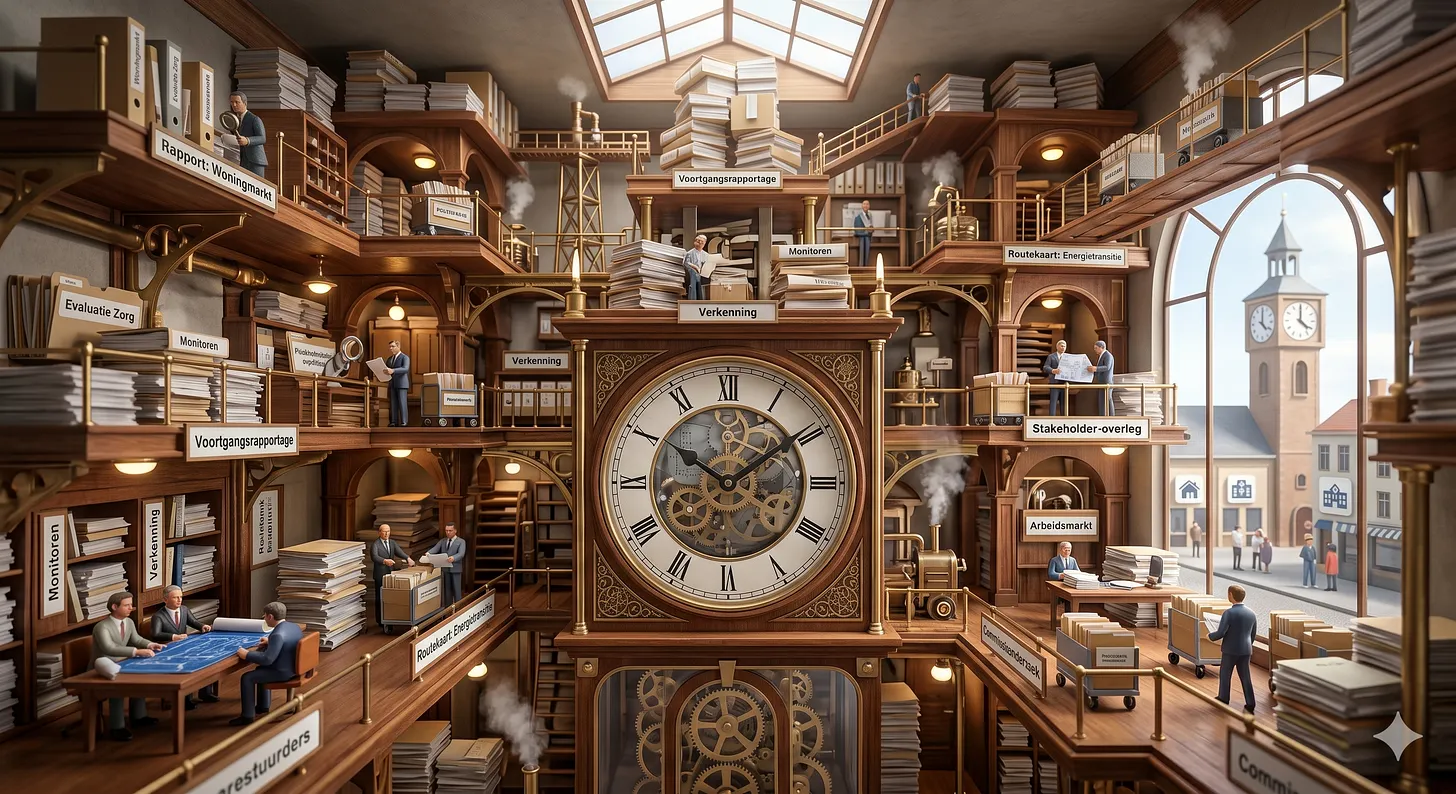
Ik weet niet precies waarom dat beeld steeds terugkomt, maar de laatste jaren bekruipt mij steeds vaker het gevoel dat een deel van onze samenleving zich op een vergelijkbare manier gedraagt. Niet omdat alles stilstaat. Integendeel. Overal zie ik activiteit. Er verschijnen rapporten, beleidsstukken, evaluaties, monitoren, voortgangsrapportages, verkenningen en routekaarten. Er worden congressen georganiseerd, experts geraadpleegd en stakeholders betrokken. Wie van een afstand kijkt, zou gemakkelijk kunnen concluderen dat een ongekende hoeveelheid mensen zich bezighoudt met de grote vraagstukken van onze tijd. Misschien is dat ook wel zo. En toch blijft er iets knagen. Niet omdat er te weinig gebeurt, maar omdat de hoeveelheid beweging soms vreemd slecht lijkt te correleren met de hoeveelheid vooruitgang.
Dat gevoel kwam niet in één keer. Zoals zoveel inzichten ontstond het eerder als een lichte irritatie waar ik geen naam aan kon geven. Ik merkte bijvoorbeeld dat ik steeds vaker artikelen las die mij een eigenaardig gevoel van déjà vu gaven. Niet omdat journalisten lui waren of omdat onderzoekers niets nieuws te melden hadden. Vaak waren de stukken uitstekend. Maar ergens halverwege het lezen begon ik te beseffen dat ik dezelfde onderliggende boodschap al jaren tegenkwam. Er was een tekort aan woningen. De druk op de zorg nam toe. Het onderwijs liep tegen grenzen aan. De uitvoering van beleid bleek ingewikkelder dan gedacht. De energietransitie vergde meer tijd dan gehoopt. De arbeidsmarkt piepte en kraakte. Iedere keer waren de cijfers anders. Iedere keer waren de betrokken bestuurders anders. Soms was zelfs het probleem net anders gedefinieerd. Toch leek het alsof de kern van het verhaal zich voortdurend herhaalde, alsof een samenleving zichzelf steeds opnieuw dezelfde diagnose stelde zonder ooit helemaal aan de behandeling toe te komen.
Misschien viel het mij juist op omdat ik beroepsmatig veel mensen tegenkom die oprecht proberen iets te verbeteren. Dat klinkt als een detail, maar het is belangrijk. De gemakkelijkste verklaring voor maatschappelijke stilstand is immers dat er ergens incompetente of kwaadaardige mensen aan de knoppen zitten. Dat is een prettig verhaal omdat het overzichtelijk is. Je kunt een schuldige aanwijzen. Je kunt boos worden. Je kunt een verkiezing winnen. Alleen komt die verklaring steeds minder overeen met wat ik in de praktijk zie. De meeste mensen die ik ontmoet zijn intelligent. Ze werken hard. Ze hebben vaak een verrassend scherp inzicht in de problemen waarmee hun organisatie, sector of land worstelt. Juist daarom voelt het soms zo vreemd dat er tussen inzicht en verandering zo vaak een leegte lijkt te ontstaan.
Een paar dagen geleden viel er tijdens een gesprek ineens een zin op zijn plek die sindsdien niet meer uit mijn hoofd verdwijnt. Het was geen zorgvuldig geformuleerde theorie en ook geen diepzinnige filosofische uitspraak. Het was eerder een observatie die zich jarenlang had verstopt tussen allerlei andere observaties.
“We zijn uitzonderlijk goed geworden in het netjes organiseren van het uitstel.”
Sindsdien gebeurt er iets vreemds. Ik weet niet zeker of het komt doordat ik werkelijk een patroon zie of doordat ik mezelf eenmaal op een gedachte heb vastgebeten. Dat risico bestaat altijd. Zodra je ergens woorden voor hebt gevonden, lijkt de wereld zich er ineens mee te vullen. Toch bleef het gevoel terugkomen. Tijdens gesprekken. In nieuwsberichten. In vergaderingen. In de merkwaardige taal waarmee organisaties hun moeilijkste problemen proberen te beschrijven. Steeds weer zag ik mensen die een probleem helder konden uitleggen en tegelijkertijd aarzelden bij de stap die op die uitleg zou moeten volgen.
Wat deze dynamiek zo lastig maakt om te herkennen, is dat uitstel tegenwoordig zelden voelt als uitstel. Het voelt als verantwoordelijkheid. Het voelt als zorgvuldigheid. Het voelt als professionaliteit. Niemand zegt dat hij een probleem voor zich uitschuift. Men zegt dat men eerst een vollediger beeld wil hebben. Dat men alle relevante belangen wil meewegen. Dat men ongewenste neveneffecten wil voorkomen. Op zichzelf zijn dat bewonderenswaardige doelen. Ik zou niet graag leven in een samenleving waarin niemand zich druk maakt over de gevolgen van zijn beslissingen. Toch vraag ik mij soms af of een beschaving ook kan verdrinken in haar eigen voorzichtigheid. Niet omdat voorzichtigheid verkeerd is, maar omdat vrijwel iedere deugd een schaduwzijde ontwikkelt zodra zij het dominante organiserende principe wordt.
Misschien is dat wel de paradox die mij de laatste tijd het meest bezighoudt. We hebben eeuwenlang geleerd dat meer kennis leidt tot betere beslissingen. Die gedachte heeft ons ongelooflijk veel gebracht en in grote lijnen geloof ik haar nog steeds. Maar zelden staan we stil bij de mogelijkheid dat kennis ook een nieuw probleem kan creëren. Iedere nieuwe studie voegt nuance toe. Iedere nuance introduceert nieuwe onzekerheden. Iedere onzekerheid rechtvaardigt aanvullend onderzoek. Iedere aanvullende analyse levert nieuwe perspectieven op die eveneens gehoord moeten worden. Voor je het weet bevindt een samenleving zich in een situatie waarin bijna iedereen begrijpt wat er aan de hand is, terwijl niemand zich nog comfortabel voelt om de onvermijdelijke sprong naar handelen te maken.
Misschien verklaart dat ook waarom zoveel mensen tegenwoordig een merkwaardige vorm van vermoeidheid lijken te ervaren wanneer zij naar nieuws of politiek kijken. Het is geen vermoeidheid die voortkomt uit desinteresse. Het is eerder het gevoel dat je krijgt wanneer je jarenlang naar een machine kijkt die luidruchtig blijft draaien zonder dat de output zichtbaar verbetert. Je hoort de motor. Je ziet de schermen oplichten. Je ziet monteurs af en aan lopen. Alles wijst op activiteit. En toch bekruipt je langzaam de vraag of de machine nog produceert waarvoor zij ooit gebouwd is.
Ik weet niet of dit essay uiteindelijk over politiek gaat. Ik vermoed van niet. Misschien gaat het zelfs niet over bestuur. Misschien gaat het over iets menselijkers en universelers. Over onze diepe behoefte om fouten te vermijden. Over onze neiging om moeilijke keuzes nog even uit te stellen in de hoop dat er morgen meer duidelijkheid zal zijn dan vandaag. Over het verlangen om zekerheid te vinden voordat we handelen, terwijl vrijwel alles wat werkelijk betekenisvol is juist plaatsvindt onder omstandigheden van onvolledige kennis. Misschien schuilt daar een spanning die ouder is dan welke moderne institutie ook. De spanning tussen begrijpen en beslissen. Tussen voorzichtigheid en verantwoordelijkheid. Tussen het verlangen naar zekerheid en het besef dat die zekerheid nooit volledig zal komen.
Misschien zit daar uiteindelijk ook de bron van het ongemak dat ik steeds vaker voel wanneer ik rapporten lees. Niet in de kwaliteit ervan. Die is vaak indrukwekkend. Ook niet in de intelligentie van de mensen die eraan werken. Die is vaak even indrukwekkend. Het ongemak ontstaat juist doordat zoveel mensen zo helder lijken te zien wat er gebeurt. Juist daardoor valt het op wanneer de werkelijkheid zich sneller ontwikkelt dan de processen waarmee wij haar proberen te begrijpen.
Misschien onderschatten we hoe verschillend die twee ritmes zijn. Een beleidsproces mag een jaar duren. Een evaluatie mag worden uitgesteld. Een commissie mag om aanvullend onderzoek vragen. Op papier is tijd verrassend flexibel. De werkelijkheid kent die flexibiliteit veel minder. Terwijl wij nog proberen onzekerheden te reduceren, verandert de context waarin die onzekerheden betekenis hebben. Terwijl wij nog discussiëren over mogelijke gevolgen, dienen de gevolgen van eerdere beslissingen zich vaak al aan. Terwijl wij nog nadenken over wat er zou kunnen gebeuren, is de toekomst soms al begonnen met het uitdelen van haar antwoorden.
De afgelopen maanden vraag ik me steeds vaker af of veel van onze problemen uiteindelijk niet voortkomen uit een gebrek aan kennis, maar uit een steeds grotere afstand tussen de snelheid van de werkelijkheid en de snelheid waarmee wij bereid zijn haar tegemoet te treden. Ik weet niet zeker of dat waar is. Maar het is een gedachte die blijft terugkomen. Vooral op momenten waarop ik weer een uitstekend rapport lees over een probleem dat ik mij herinner uit een ander uitstekend rapport van vijf jaar geleden.
Misschien is dat ook de reden waarom ik steeds weer aan dat oude horloge moet denken. Het zag er nog prima uit. De wijzers stonden overtuigend op hun plek. Van een afstand leek alles normaal. Alleen bleek de tijd ondertussen ergens anders te zijn doorgegaan.
Herken je dit gevoel? Waar zie jij voorbeelden van 'georganiseerd uitstel' in je eigen werk of omgeving? Laat het me weten in de comments.
ENGLISH VERSION
The Careful Architecture of Delay
Why we grow ever more adept at organizing that which we do not dare to execute.
JEROEN KJM SPARLA
MAY 31, 2026
This essay began with a broken watch and a sense of unease. Why does it feel as though we inhabit a society that revolves noisily, yet does not advance? A reflection upon knowledge, procrastination, and the courage to act.
During the past weeks, I have found myself turning, with an unexpected frequency, to the memory of an old watch that lay for years within a drawer of my desk. It possessed no singular value, nor did it keep time with any exceptional precision, yet there was something peculiar in its nature. Whenever it fell still, the cessation was not immediately apparent. The hands remained poised at a plausible hour. Even hours later, one might look upon it without directly perceiving that the mechanism had long since ceased its labor. Only when one happened to glance at another timepiece, or when another soul imparted the true hour of the day, did the realization dawn that the watch had, through all that interval, done nothing more than sustain the impression of time.
I cannot say precisely why that image returns to me with such persistence, but in recent years a conviction has increasingly stolen over me that a portion of our society comports itself in a comparable manner. Not because everything has ground to a standstill. On the contrary. Everywhere I look, I discern activity. There appear reports, policy documents, evaluations, monitors, progress updates, explorations, and roadmaps. Congresses are organized, experts consulted, and stakeholders engaged. Whoever looks upon this from a distance might easily conclude that an unprecedented multitude of minds is occupying itself with the great questions of our age. Perhaps that is indeed the case. And yet, something continues to gnaw. Not because too little occurs, but because the sheer volume of motion appears, at times, to correlate strangely poorly with the volume of progress.
That impression did not arrive all at once. Like so many insights, it arose rather as a slight irritation for which I possessed no name. I noticed, for instance, that I was reading articles with increasing frequency that bestowed upon me a peculiar sense of déjà vu. Not because the journalists were idle, or because the researchers had nothing novel to impart. Often, the pieces were excellent. But somewhere midway through the reading, I began to realize that I had been encountering the selfsame underlying message for years. There was a scarcity of housing. The pressure upon healthcare was intensifying. Education was encountering its limits. The execution of policy proved more labyrinthine than had been presumed. The energy transition demanded more time than had been hoped. The labor market creaked and groaned. Each time, the figures were different. Each time, the governing officials involved were different. Sometimes, even the problem itself was defined slightly differently. Yet it seemed as though the core of the narrative perpetually repeated itself, as if a society were continuously pronouncing the same diagnosis upon itself without ever quite arriving at the treatment.
Perhaps it struck me precisely because, in my professional life, I encounter many individuals who are genuinely endeavoring to amend something. That sounds like a detail, yet it is important. For the easiest explanation for societal stagnation is that there are incompetent or malevolent people at the controls somewhere. That is a comforting narrative because it is uncomplicated. One can point to a guilty party. One can become angry. One can win an election. Only, that explanation corresponds less and less with what I observe in practice. Most people I meet are intelligent. They work diligently. They possess, frequently, a surprisingly sharp insight into the tribulations with which their organization, sector, or country wrestles. Precisely for that reason, it feels so strange at times that between insight and transformation, a void so often seems to open.
A few days ago, during a conversation, a sentence suddenly fell into place that has not left my mind since. It was no carefully formulated theory, nor was it a profound philosophical utterance. It was rather an observation that had hidden itself for years among all manner of other observations.
“We have become exceptionally good at neatly organizing our delay.”
Since then, a strange thing has happened. I am not certain whether it is because I truly discern a pattern, or because I have once and for all fastened my mind upon a single thought. That risk always exists. As soon as one has found words for something, the world appears suddenly to fill itself therewith. Yet the feeling kept returning. During conversations. In news despatches. In meetings. In the curious language with which organizations attempt to describe their most intractable difficulties. Time and again, I saw people who could explain a problem with clarity, and who simultaneously hesitated at the step that ought to follow upon that explanation.
What renders this dynamic so difficult to recognize is that delay, in our contemporary world, seldom feels like delay. It feels like responsibility. It feels like thoroughness. It feels like professionalism. No one says that they are pushing a problem ahead of themselves. It is said that one wishes first to have a more complete picture. That one desires to weigh all relevant interests. That one wants to prevent undesirable side-effects. In themselves, these are admirable aims. I should not care to live in a society wherein no one troubled themselves over the consequences of their decisions. Yet I ask myself at times whether a civilization can also drown in its own caution. Not because caution is erroneous, but because virtually every virtue develops a shadow side as soon as it becomes the dominant organizing principle.
Perhaps that is the paradox that occupies me most of late. We have learned for centuries that greater knowledge leads to better decisions. That thought has brought us an incredible bounty, and in broad strokes, I believe it still. But rarely do we pause before the possibility that knowledge can also create a new problem. Every new study adds nuance. Every nuance introduces new uncertainties. Every uncertainty justifies additional research. Every supplementary analysis yields new perspectives that must likewise be heard. Before one knows it, a society finds itself in a situation wherein almost everyone understands what is occurring, while no one feels comfortable any longer making the inevitable leap into action.
Perhaps that explains also why so many people nowadays appear to experience a curious form of weariness when they look upon the news or politics. It is not a weariness born of disinterest. It is rather the sensation one receives when watching for years a machine that continues to revolve noisily without its output visibly improving. One hears the engine. One sees the screens light up. One sees mechanics coming and going. Everything points to activity. And yet, the question slowly creeps over you whether the machine still produces that for which it was once constructed.
I do not know whether this essay, in the end, concerns politics. I suspect not. Perhaps it does not even concern governance. Perhaps it concerns something more human and more universal. Touching our deep need to avoid error. Touching our inclination to defer difficult choices just a little longer in the hope that tomorrow there will be more clarity than exists today. Touching the longing to find certainty before we act, whereas virtually everything that is truly meaningful takes place precisely under conditions of incomplete knowledge. Perhaps there slumbers a tension there that is older than any modern institution. The tension between understanding and deciding. Between caution and responsibility. Between the desire for certainty and the realization that such certainty will never fully come.
Perhaps therein lies, ultimately, the source of the discomfort I feel with increasing frequency when I read reports. Not in the quality of them. That is often impressive. Nor in the intelligence of the people who labor upon them. That is often equally impressive. The discomfort arises precisely because so many people seem to see so clearly what is happening. Just because of that, it becomes noticeable when reality develops more rapidly than the processes by which we attempt to comprehend it.
Perhaps we underestimate how different those two rhythms are. A policy process may take a year. An evaluation may be postponed. A committee may request additional research. On paper, time is surprisingly flexible. Reality knows that flexibility far less. While we are still attempting to reduce uncertainties, the context in which those uncertainties possess meaning changes. While we are still debating potential consequences, the consequences of earlier decisions frequently already present themselves. While we are still contemplating what might occur, the future has sometimes already begun dispensing its answers.
During the past months, I have asked myself more and more whether many of our problems do not stem, ultimately, from a lack of knowledge, but from an ever-growing distance between the velocity of reality and the velocity with which we are prepared to move out to meet it. I am not certain whether that is true. But it is a thought that remains, returning to me. Especially at moments when I read yet another excellent report concerning a problem that I remember from another excellent report of five years ago.
Perhaps that is also the reason why I must think time and again of that old watch. It still looked perfectly well. The hands stood convincingly in their place. From a distance, everything appeared normal. Only, time turned out, in the meanwhile, to have gone on somewhere else.