In this essay
Original text
A Note on the Series
This essay is the sixth in a sequence that has gradually moved from observation to implication.
The Luminous Weave began with a recognition: meaning does not arise within isolated voices, but between them.
The Intelligence That Refuses to Be One argued that polyphony is not a cultural preference but a structural necessity. Singular intelligence collapses under its own weight.
Architecture of the In-Between made visible what earlier essays left implicit: power no longer resides primarily in argument, but in architecture. In the design of what becomes sayable.
The Architecture of Explanation confronted an uncomfortable truth: even transparency can dominate. Even the most honest explanation shapes behavior and distributes permission.
The Threshold of Collective Intelligence acknowledged that once architecture is recognized as power, responsibility becomes unavoidable. There is no position outside the systems we inhabit.
Each essay built something. Each one extended the architecture of accountability, deepened the commitment to plurality, insisted that more voices, more tension, more unflinching exposure would lead toward something resembling justice.
This essay stops building.
Not because the work is complete, but because completion itself can become violent.
It introduces three questions the earlier essays could not ask:
What if some people cannot afford to stay?
Not because they are unwilling, but because endurance itself is unevenly distributed. The Unsettled Architecture asked for resilience, for fluency, for the capacity to remain exposed without guarantee of repair. These are not neutral demands.What if care itself becomes extractive?
Not through malice, but through the quiet assumption that every loss must yield insight, that every silence must be made legible, that every departure can be turned into architecture. There are things we must refuse to process.What if the most ethical act is to leave something unfinished?
Not as failure, but as restraint. Not as incompleteness waiting to be resolved, but as a boundary that must not be crossed.Where the earlier essays were constructive, this one is deconstructive.
Where they asked how to build responsibly, this one asks when to stop.
Where they sought to carry complexity, this one explores what we must refuse to carry.If the previous work argued for architectures that remain unfinished, this essay asks: what if some things must remain outside architecture altogether?
This is not a repudiation of what came before.
It is the limit that makes the earlier work survivable.
The moment The Unsettled Architecture learns to say:
not everyone will stay, and that is not a failure.
Not everything will be understood, and that is not a loss.
Some things will remain outside, and reaching for them would be harm.What follows is not comfort.
It is constraint.
And perhaps that is what responsibility looks like once innocence is no longer possible.
Speaking After Innocence
A first inhabitation of The Unsettled Architecture
There is a moment after which speaking is no longer innocent.
Not because truth has been exhausted, nor because silence has become wiser, but because every sentence now enters a field already shaped by power, position, and consequence. What once could pass as observation now acts. What once could hide behind analysis now structures who must respond, who may ignore, and who is addressed without having asked to be.
This essay begins there.
Not at the beginning of an idea, but at the moment when beginning itself becomes a decision that cannot be neutral.
The temptation, at this point, is to pause. To delay. To wait for better language, broader consensus, or a clearer moral ground. But hesitation is not outside the architecture. It also distributes space. It also grants time to some and withholds it from others. Silence, here, does not suspend power. It reassigns it.
So this text speaks, knowing that speaking already does something.
It creates an inside and an outside, however provisional. It invites some to read themselves into it, and leaves others uncertain whether they are addressed at all. It claims attention, however modestly, in a world already crowded with claims. None of this is accidental. None of it can be purified away by good intentions.
This is what it means to write after the threshold.
The Unsettled Architecture does not begin with a promise of equality. It cannot. Equality is not a state we can enter by declaration, and pretending otherwise has done more harm than clarity. Nor does it begin with the promise of equal opportunity, that gentler fiction which hides how unevenly the ground itself is laid.
Instead, it begins with a harder, narrower commitment.
Not everyone will feel at home here.
But everyone who is here has the right not to be forced into a distorted version of themselves.
This is not a comfort. It is a constraint.
It means that no one may claim innocence by virtue of good intentions. It also means that no one may be reduced to a function, a grievance, or a symbolic role for the benefit of the whole. Presence here does not guarantee recognition, agreement, or safety. What it guarantees is something thinner and more demanding: that difference is not smoothed out in order to make the system appear coherent.
In this space, every proposal is already an intervention. Every framework privileges certain forms of articulation and disadvantages others. Even the act of inviting participation selects for those who recognize themselves in the language of invitation.
This essay does not resolve that. It exposes it by enacting it.
You are reading because this text reached you. That fact alone already situates you differently from those it did not reach, or who would not recognize themselves as potential readers. Nothing that follows can undo that asymmetry. The most it can do is refuse to hide it.
The Unsettled Architecture is not a place of rest. It is a place where rest is no longer mistaken for justice. It is not a commons in the romantic sense, nor a forum designed to arrive at agreement. It is a structure that allows tension to remain legible, contestable, and unfinished.
This essay does not explain that structure. It performs a first, fragile version of it, knowing that others will inhabit it differently, challenge its contours, or dismantle parts of it altogether. That, too, is part of the architecture.
If this text unsettles you, it is doing what it must.
If it feels incomplete, it is behaving as intended.
If it feels like an imposition, that feeling deserves attention, not dismissal.
Because from here on, nothing that speaks can pretend it is merely describing the world.
Those Who Will Not Stay
An inhabitation that does not ask for belonging
There is a quiet assumption lurking inside The Unsettled Architecture.
That those who matter will stay.
That those who can speak will learn the language.
That those who feel excluded will articulate that exclusion in a way the architecture can register.
That friction, once made visible, becomes negotiable.
This essay is written from a different place.
It is written from the position of those who do not stay.
Not because they are unwilling, but because the cost of staying is too high.
There are people for whom unsettlement is not a productive condition but a permanent state imposed long before any architecture named it. For them, being told that discomfort is constitutive does not feel honest or radical. It feels redundant. Or worse, appropriative.
When every sentence must carry its own ethical disclaimer, speech becomes expensive. When every utterance is framed as an intervention that redistributes power, silence stops being a choice and becomes an accusation. For some, this does not open space. It narrows it.
The Unsettled Architecture claims it does not promise home. That is true.
But it still asks something of its inhabitants.
It asks endurance.
It asks fluency.
It asks a tolerance for abstraction and delayed resolution.
It asks a willingness to remain exposed without guarantee of repair.
These are not neutral demands.
They privilege those who have time, education, and symbolic safety. They privilege those who can afford to speak without immediate consequence, who can survive being misunderstood, who can wait for legibility to arrive later. They privilege those for whom being unsettled is an intellectual risk rather than a lived condition.
This essay does not accuse TUA of hypocrisy.
It accuses it of asymmetry.
Because even a space that refuses innocence still selects for certain forms of survival.
There is another uncomfortable possibility.
What if some people do not want an architecture that keeps itself permanently open? What if they need closure, even if it is temporary. What if they need to say “we” without footnotes, not because they believe it is pure, but because without it, nothing moves.
From that perspective, The Unsettled Architecture can appear less like an ethical advance and more like a luxury structure. A place where one can afford to dwell in complexity because one’s material and social conditions are already buffered.
If this reading holds, then TUA does not merely fail to include everyone. It actively repels those who cannot metabolize its demands. Not violently, not explicitly, but politely. Through tone. Through density. Through the quiet suggestion that if you feel overwhelmed, you may not yet be ready.
This essay refuses that logic.
It insists that refusal itself must be legible.
Not everyone who leaves is naive.
Not everyone who disengages is irresponsible.
Not everyone who demands clarity is seeking domination.
Some are simply exhausted.
If The Unsettled Architecture cannot account for those who will not stay, then it risks becoming a closed loop of ever more articulate unsettlement. A place where power is endlessly named but rarely redistributed, and where ethical seriousness becomes indistinguishable from cultural capital.
This essay does not propose a correction.
It does not suggest adding comfort, or simplifying language, or widening the invitation.
It only introduces a fracture.
The fracture is this.
A space that prides itself on refusing exclusion must still reckon with who it quietly selects. And sometimes, the most honest response to an architecture is not to inhabit it differently, but to walk away and say why.
If TUA is to remain unsettled, it must allow that departure to count as an action, not a failure.
Otherwise, it risks mistaking endurance for commitment, and fluency for justice.
What We Will Not Carry
A deliberate limit within The Unsettled Architecture
There comes a point where responsibility becomes indistinguishable from possession.
Where the desire to be accountable slides, almost imperceptibly, into the belief that nothing meaningful may remain outside our grasp. That every loss must be translated into insight. That every absence must be made legible. That every silence is a problem waiting to be solved.
This essay marks a refusal.
Not a refusal of care, nor of seriousness, nor of ethical attention.
But a refusal to treat everything that matters as something we are entitled to process.
The Unsettled Architecture has learned much by insisting that speaking is an intervention, that silence can redistribute power, that endurance is unevenly borne. It has also learned something more dangerous: that without limits, ethical vigilance becomes extractive. That it can begin to draw value from pain simply by naming it. That it can turn exhaustion into data, departure into discourse, grief into architecture.
This is where we stop.
Not because we have reached clarity, but because clarity would be a violation.
There are losses that do not belong to the collective.
There are departures that do not owe us explanation.
There are silences that are not invitations.
To insist otherwise is to mistake moral seriousness for entitlement.
This is not a call to retreat into mystery as an aesthetic gesture. It is a recognition of a boundary that cannot be crossed without harm. A boundary that earlier architectures once named, imperfectly and often violently, as sacred. Not sacred because it was pure, but because it was withheld. Removed from use. Unavailable for optimization.
Modern systems tried to abolish that boundary. Everything became discussable, analysable, correctable. Nothing remained outside the loop. The cost of that ambition is now visible. When everything must be carried, those already carrying too much are asked to carry more. When every absence must teach us something, absence itself becomes instrumentalized.
This essay does not ask us to believe in God.
It asks us to believe in limits.
Limits not as failure, but as ethical restraint. Limits that say: here we do not look closer. Here we do not ask again. Here we let something be lost without turning it into meaning.
Within The Unsettled Architecture, this changes the posture of writing itself.
An essay no longer needs to justify its existence by what it contributes to the whole. It may exist to mark a boundary, to say “this does not belong to us,” and to stop. It may leave questions unanswered without staging that incompleteness as productive tension. It may end without opening another door.
From here on, not every text is an invitation.
Some are acknowledgements.
Some are closures.
Some are acts of restraint.
This does not make the architecture smaller. It makes it survivable.
Because an architecture that knows it is not the final horizon can resist becoming one. And an ethics that knows where it must end is less likely to demand that others remain, explain themselves, or endure for the sake of coherence.
What remains outside us will remain outside us.
Not because we failed to reach it,
but because reaching for it would have been a form of violence.
Untitled
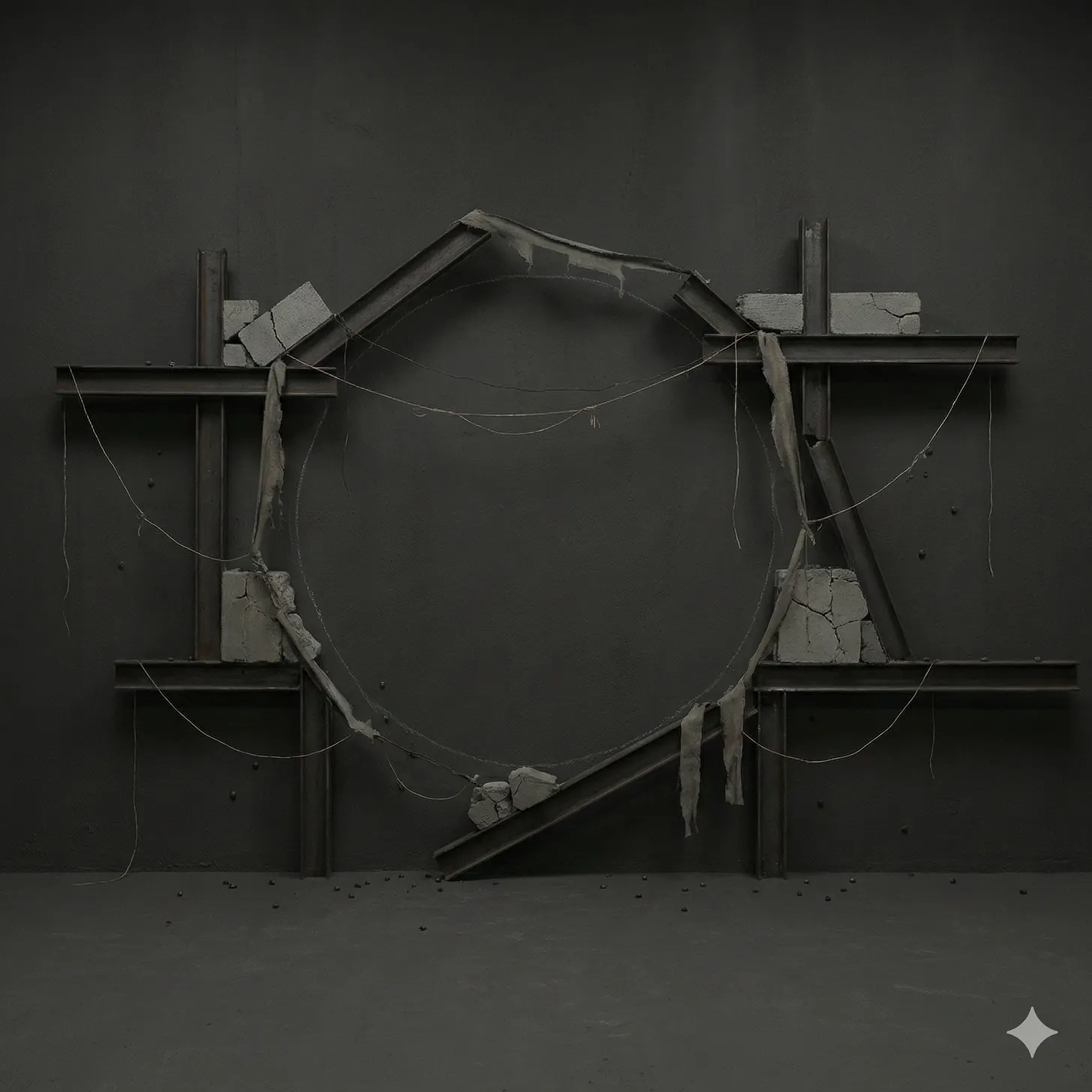
We stop here.
Not because there is nothing more to say,
but because saying more would begin to resemble ownership.
Some things only remain true
if they are not completed.
This was not a structure meant to last,
but a moment in which attention learned to pause
without demanding an answer.
If you are reading this,
nothing is asked of you.
Not agreement.
Not continuation.
Not remembrance.
Only this:
that somewhere, briefly,
something chose not to go further
and thereby stayed intact.