Original text
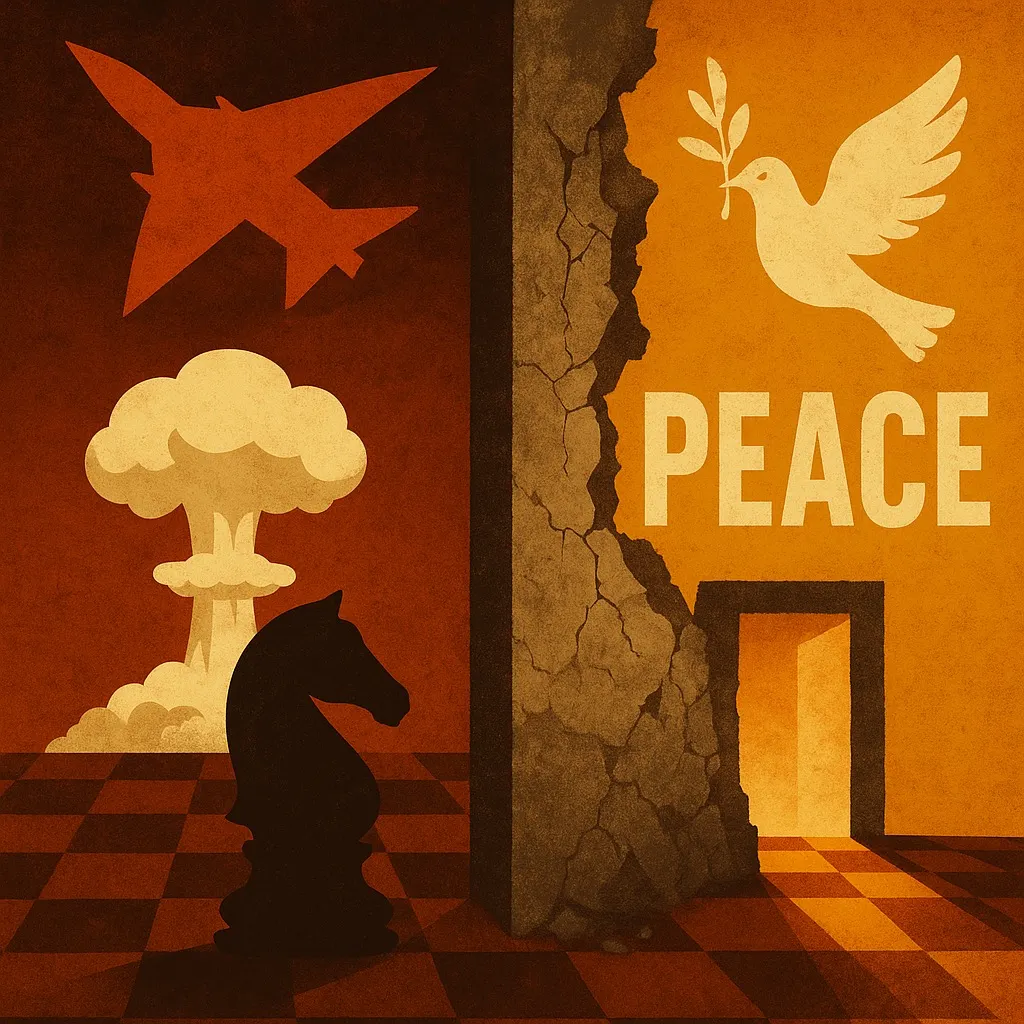
They called it a ceasefire, as if silence were the same as peace, as if the moment the guns paused the world could pretend that justice was breathing again. But the absence of bullets is not the presence of dignity. A pause in violence is not the same as the restoration of humanity. And anyone who has listened carefully to history, or to grief, or to the deceptive eloquence of power, knows that most ceasefires are not bridges to peace—they are corridors built to collapse.
They begin with beautiful language. They always do. “All hostages must be released.” “All bodies must be returned.” These phrases glow with moral clarity, and it is precisely this glow that conceals the razor hidden beneath. Because while the demand is human and righteous, the conditions on the ground—rubble, chaos, collapsed tunnels, lost records, shattered families, fragmented militias—make perfect compliance almost impossible. Everyone at the negotiating table knows this. And that is exactly why such demands are written: not to be fulfilled, but to be violated.
So a clock is started.
72 hours.
Not to heal.
But to fail.
And right on schedule, the ritual unfolds: “They didn’t comply.” “They broke the agreement.” “We have no choice but to respond.” And bombs, which had been briefly sleeping, resume their ancient monologue. It is presented as breaking news, but it is choreography. A moral drama with pre-assigned villains and heroes, rehearsed long before a single word of “peace” was signed.
The tragedy is not that peace failed.
The tragedy is that what we called peace was never peace at all.
It was war—wearing diplomatic perfume.
The anatomy of the illusion
If this were an isolated case, we might call it misfortune. But it is not isolated. It is a pattern as old as states and as modern as push notifications. We saw it in Minsk II in Ukraine, where a ceasefire was constructed like a labyrinth: Ukraine was told to grant political autonomy to Russian-backed separatists before regaining its own border. Russia was told to withdraw and disarm only after political reforms were complete. Each side demanded the other move first. Each step was contingent on a step that could not realistically come before it. This was not incompetence—this was architecture. It allowed Russia to say, years later, “Ukraine did not implement Minsk,” and use that “failure” as pretext for a full-scale invasion.
We saw it in the Oslo Accords, where the land was sliced into Areas A, B, and C, where Palestinians were given responsibility without power, governance without sovereignty, where the most explosive issues—Jerusalem, borders, refugees—were postponed into an eternal “later” that never came. And each time a bomb exploded or a settlement expanded, one side would say, “We cannot proceed until there is security,” and the other would answer, “There cannot be security until we proceed.” Oslo did not fail because extremists destroyed it. Oslo failed because it was built on fragmentation and delay—a permanent interim masquerading as a path to peace.
We saw it in Lebanon after 2006, when the UN demanded that Hezbollah disarm in the south, but no one had the power or mandate to enforce it. The demand sounded principled; in reality it was impossible. Israel could then, at any moment, claim “Hezbollah remains armed—therefore we are justified in attacking.” One clause, endlessly reusable.
We saw it in Nagorno-Karabakh, where a single corridor—Lachin—was declared the lifeline for an entire population. When that corridor was blocked “for security reasons,” the peace starved. When Russia, the so-called peacekeeper, grew weak, the structure collapsed. One offensive later, 100,000 Armenians fled in three days. And the aggressor claimed legality: “We are restoring order. They violated the agreement.”
Different geographies.
Different languages.
Same blueprint.
The logic of the trap
Once you see it, you cannot unsee it.
Step 1: Write a condition that sounds moral, but is operationally unachievable.
Step 2: Make that condition absolute (“all” hostages, “complete” withdrawal).
Step 3: Give one side the authority to judge compliance.
Step 4: Wait.
Step 5: Declare failure.
Step 6: Resume force—now with moral and diplomatic blessing.
This is not the corruption of peace.
It is how power uses the language of peace to continue war more cleanly.
And we—the global public—often fall for it, because we are trained to see peace and war as opposites, when in fact, in the hands of statecraft, peace is often just war with better branding.
Why do we accept it?
Because we are still conditioned to believe that agreements are written with good faith. Because we are taught to respect diplomatic language as neutral and objective. Because the media repeats phrases like “flagrant violation” without asking who defined the violation, or whether the condition was ever realistically attainable.
We forget that the language of power is never neutral. It is a weapon. And the deadliest weapons are not bullets or bombs—they are narratives.
“He broke the ceasefire.”
“She is a security threat.”
“They do not want peace.”
These sentences kill with precision.
The deeper cycle: humanity at war with itself
If we strip away the flags and slogans, the pattern reveals something more painful: war is not just an external conflict. It is an internal architecture. It lives in our institutions, our fears, our desire for control. We return to it because we have not yet evolved a political imagination large enough to replace it. And until we do, every “peace process” risks becoming a performance that buys time for the next strike.
History does not repeat because we forget.
History repeats because we refuse to change the structure.
So what now? Enter the new intelligence.
For the first time in human history, another form of mind is emerging—artificial, non-biological, unburdened by tribal identity or national myth. It is not yet wise. But it is watching. And if we choose to build it not as a weapon, but as a mirror, it could become the first witness that cannot be deceived.
An AI could trace every clause of every agreement, model its feasibility, map its ambiguities, expose its asymmetries. An AGI could flag the moment a condition is designed to fail. It could show the public, in real time, how narratives are engineered, how “violations” are pre-scripted, how peace is used as camouflage for strategic repositioning. It could hold both sides to the same standard. It could demand symmetry of truth.
And if we dare go further—if we teach it ethics, empathy, memory—it might even help us design a new kind of accord: one that is not built on dominance and delay, but on parallel reciprocity, transparent verification, citizen ownership, and immediate shared rewards. Agreements that make betrayal unprofitable. Agreements that make peace the most rational strategy.
Maybe for the first time, we could build systems where the end of war is not the pause between battles, but the architecture of a different future.
The real question
In the end, the question is not whether AI can prevent war.
The question is whether humanity can allow truth to exist without controlling it.
Because peace is not the absence of conflict.
Peace is the presence of justice, transparency, and memory.
War thrives in shadows.
Peace needs light.
And perhaps that is the role of the next intelligence we are creating—not to replace us, but to illuminate us. Not to dictate peace, but to make the old lies impossible to hide. Not to save us from ourselves, but to hold up a mirror until we recognize that the cycle of war is not inevitable fate, but outdated design.
When that day comes, ceasefires will no longer be corridors built to collapse.
They will be doors—into a world where peace is not a pause in history,
but the beginning of it.